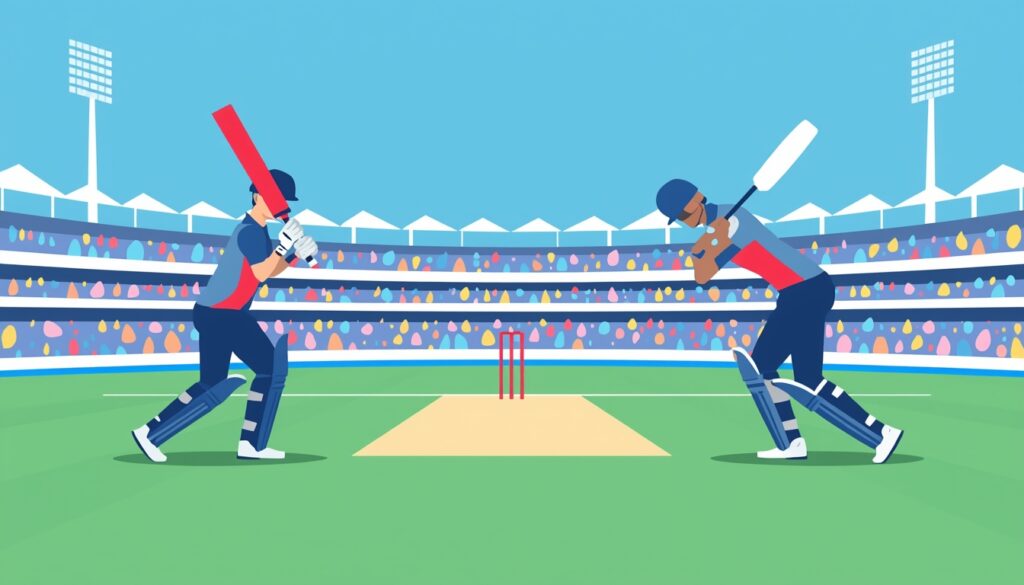
The IPL league is contested by eight teams representing eight cities in India. Fans of the game get to see some of the best cricket players in the world while enjoying Bollywood music and entertainment from cheerleaders during the intermissions.
For Indians, cricket is more than a game. As the dominant sport in India, it has a massive fan base throughout the country. It is also the highest-earning national sport. It’s strong sponsorships and star players generate 60% of cricket revenues worldwide.
The inaugural season of 2008 was watched by 200 million Indians on TV and 10 million overseas viewers, overtaking the record 150 million viewers that had previously tuned into football’s English Premier League. The IPL became the world’s sixth-biggest sports league within two seasons.
What is cricket and what are the rules of the game
Similar to baseball, cricket is a bat-and-ball team sport. Each team is composed of 11 players, with teams taking turns to bat and field.
The objective of the game is to score more runs than the other team, with the batsmen creating runs by striking the ball and running the length of the pitch at the center of the field.
The fielding side aims to dismiss the batsman by hitting the wickets behind him or catching the ball after it has been hit, but before the ball hits the ground.
Originating in England in the 16th century, cricket is the world’s second most popular sport after football. Influenced by the British Empire, today’s major cricketing countries are members (or former members) of the Commonwealth, including Australia, India, Pakistan, and England itself.
The red ocean of Indian cricket
The Board of Control for Cricket in India (BCCI) is the governing body that regulates all cricket matches played in India. Until 2008 the BCCI was swimming in a red ocean of competition.
It had monopolistic power, operated in a lucrative industry, and was the richest sports body in India. As such, the BCCI had little incentive to change or innovate the way it operated.
Many organizations in this position focus on what they are comfortable doing. Content with the status quo and well equipped to outdo the competition, they don’t see a need to innovate until it is too late.
The BCCI focused on increasing the number of cricket matches rather than creating new value for cricket fans. The league seemed set up more for the sake of the players than for spectators and failed to attract mass attention.
Not surprisingly, Indians were much more interested in the international cricket matches played by the national team than the domestic championships.
On top of that, the BCCI was not run professionally and for the good of the game revenue never trickled down to improve infrastructure or support local cricket talents. As such, there opened up a large chasm between two strategic groups: national teams and local teams.
The as-is strategy canvas of the domestic cricket league
The as-is strategy canvas of the domestic cricket league helps us understand the red ocean scenario of Indian cricket. At this time, domestic cricket leagues were played in either Test (five-day) or ODI (one-day) formats among the local and regional cricket associations. Competing factors included limiting players to national boundary and calling on players and spectators to invest time and perseverance in the game (see below).
Introducing a faster-paced game Twenty20 cricket
In England, in 2003, a new format was introduced to cricket, offering spectators a fast-paced alternative to the longer, traditional forms of the game. Twenty20 cricket is a more TV-friendly version, lasting three hours per match.
As opposed to test and one day cricket, Twenty20 is a faster, more aggressive game. Each team is only given twenty overs (120 balls) to score runs. Initially rejected by traditional cricket fans for ruining the tradition and style of cricket, Twenty20 is now overwhelmingly popular 76% of cricket viewers prefer Twenty20 over test- and one-day cricket. It was this format of the game that the BCCI adopted for the IPL.