Rain Rule in Cricket Explained: How DLS Method Changes a Match Cricket is a game where the story of a match can change with every ball. But sometimes the game is not changed by a bowler or batter, it is changed by rain. The moment rain starts pouring, the whole stadium goes quiet. Fans look at the sky, players wait inside the dressing room and everyone keeps asking the same question: what will happen now?
That is where an important topic comes in: rain rule in cricket explained.
Many new cricket fans often feel confused when the target suddenly changes after rain. For example, a team may first need 190 runs to win, but after rain stops, the target can become 130 runs in just 15 overs. It may look strange at first, but this rule is not only about mathematics. It is mainly used to keep the match fair for both teams.
Because cricket is not only about skill and competition — it is also about fairness and balance in every situation.
What Is the Rain Rule in Cricket and Why Does It Matter?
A cricket match is going on smoothly, and suddenly rain starts falling. The game stops, covers come onto the field, and everyone waits for the rain to end. After some time, the match started again but now there is a problem. Earlier, the game was supposed to be 50 overs, but after the delay, only 30 overs are left. So what will be the new target for the chasing team? That is where the rain rule comes into the picture.
In simple terms, rain rule in cricket explained means understanding how cricket decides a fair target when rain interrupts a match.
In the old days, this was handled in a very simple way. Officials mostly looked at the average run rate and changed the target based on that. But many times, it did not feel fair at all.
Imagine your team is batting carefully because the plan is to attack in the final overs. Suddenly, rain arrives and many overs are reduced. Within moments, your entire strategy is ruined. The chance to score freely at the end disappears. For players and fans, it can feel frustrating and even heartbreaking.
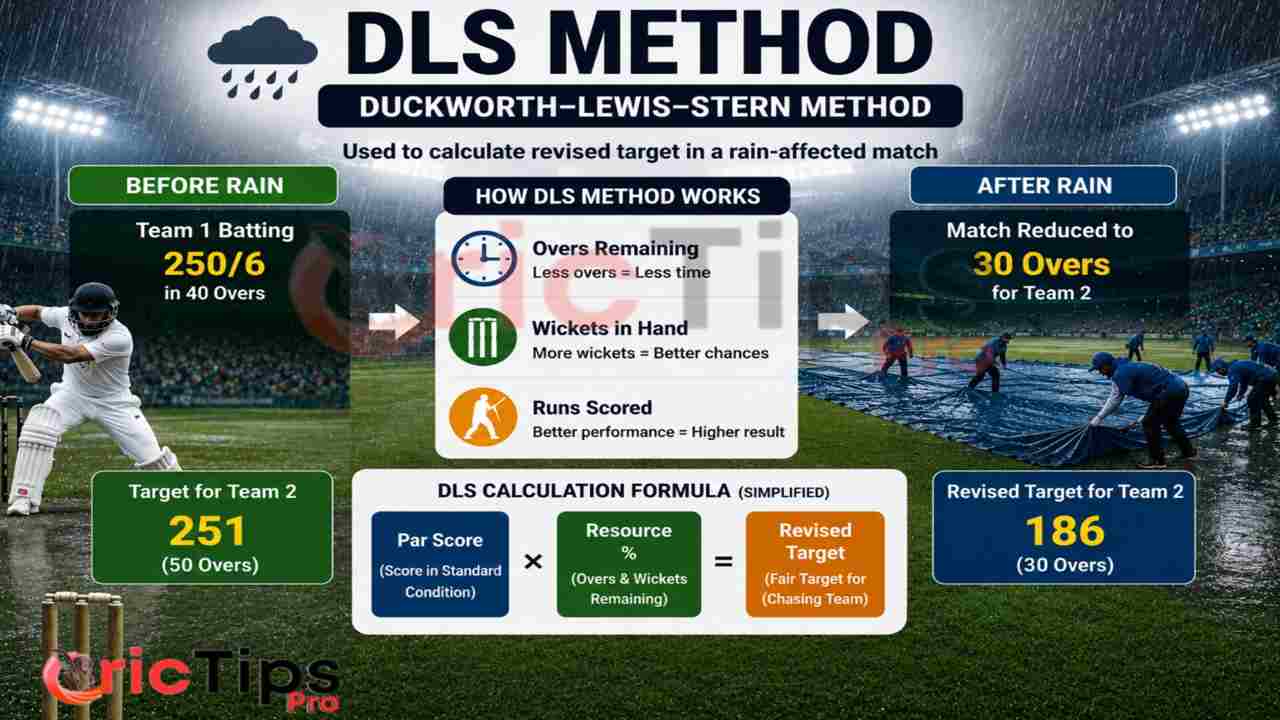
To solve this problem, cricket introduced the Duckworth-Lewis-Stern Method, better known as the DLS Rule. This system is used to keep the game fair and balanced.
The DLS method doesn’t just count the runs. It also looks at how many overs are left and how many wickets are left. Taking all these factors into account, it sets a target that gives both teams a fair chance to win.
Today, this system is used in almost every international ODI and T20 match. The players trust it, the fans understand it better and the game seems more balanced even when rain tries to change the story of the match.
Why Does the Target Change in a Rain-Affected Cricket Match?
This is the moment when most cricket fans become surprised and confused.
Suddenly, the scoreboard changes.
Commentators start talking about a new target.
And fans begin wondering how did the score change so quickly?
In simple words, rain rule in cricket explained means understanding why the target is adjusted when rain reduces the number of overs in a match.
The reason is simple. When overs are reduced, the batting team also loses some of its scoring opportunities. That is why the target cannot stay the same and must be recalculated fairly.
For example, imagine the first team scores 180 runs in 20 overs.
But because of rain, the second team gets only 15 overs to bat.
Now asking them to chase the full 181 runs in just 15 overs would feel almost impossible and unfair. So the DLS method creates a revised target, which could become around 145 or 150 depending on the match situation.
This revised target helps keep the game balanced and fair for both teams.
And honestly, this is also where cricket becomes even more emotional and exciting. Sometimes just one boundary, one dot ball, or one wicket can completely change the DLS equation and turn the entire match upside down. That is why rain-affected matches often create some of the most dramatic moments in cricket history.
Why Is the Rain Rule Different in Test Cricket?
Many cricket fans think the same rain rules are used in every format. But Test cricket is completely different.
In Test matches, there is no revised target system like ODI or T20 cricket.
The reason is simple Test cricket is a time based format, not an over based format. In limited-over matches, every team gets a fixed number of overs. But in Test cricket, the game is played over five days, and overs are not fixed in the same way.
If rain causes a lot of time to be lost and the match cannot reach a proper result within five days, the game simply ends as a draw.
Sometimes umpires try to recover the lost time by adding extra overs or extending play. But even after that, if no team can force a result, the match finishes without a winner.
And honestly, this is part of the unique beauty of Test cricket.
Test cricket is not only about scoring runs quickly. It is also about patience, survival, smart planning, and managing time under pressure. Sometimes a team fights for hours just to save the match, and that emotion makes Test cricket special for true fans.
That is why, to fully understand rain rule in cricket explained, it is important to know that rain rules change depending on the format of the game.
Conclusion
In the end, cricket is not only about runs and wickets. It is also about fighting against situations, pressure, and unexpected moments.
When rain arrives during a match, it does not just stop the game it changes emotions, plans, momentum, and sometimes even hope itself.
And in those chaotic moments, the DLS system and rain rules help keep cricket fair, balanced, and organized.
So the next time you watch a rain-interrupted match, do not only focus on the revised target.
Try to notice the deeper story behind it:
Which team lost more overs
How many wickets are still left
Why the target changed
And which side handled the pressure better
Because the real beauty of cricket lives there.
Cricket is not only a game of power and big shots. It is a beautiful mix of intelligence, patience, timing, strategy, and fairness.
And maybe that is why, even when rain falls and the skies turn dark, the story of cricket never truly stops.
What is the rain rule in cricket?
The rain rule in cricket is used when bad weather interrupts a match. It helps officials decide a fair target for the team batting second after overs are reduced because of rain.
What does DLS mean in cricket?
DLS stands for Duckworth-Lewis-Stern Method. It is a mathematical system used in ODI and T20 matches to calculate a revised target during rain-affected games.
Why does the target change after rain in cricket?
The target changes because the chasing team gets fewer overs to bat after rain delays the match. The DLS method adjusts the score fairly by considering overs and wickets remaining.