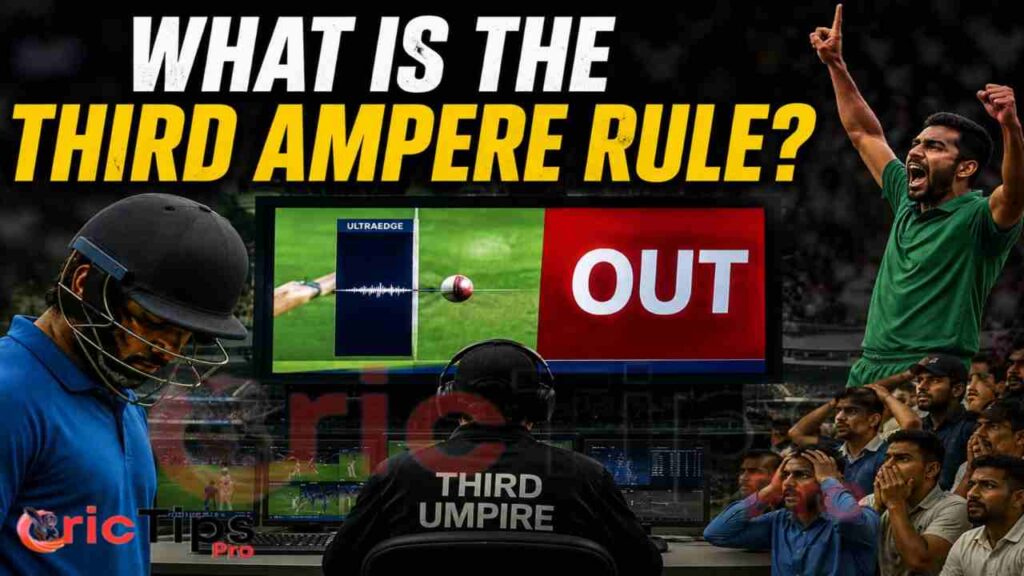
Sometimes a cricket match suddenly becomes very tense.
Everyone waits quietly for the decision.
Was the batter safe inside the crease?
Did the ball touch the boundary rope?
Was it out or not out?
These small moments can change the whole match. That is why the third umpire rule is so important in cricket today.Earlier, only the on-field umpire gave the final decision.
Now technology helps the game. A third umpire watches video replays from outside the field and checks the moment from different camera angles before making the final call.
Because of this rule, cricket has become more exciting and fair.One close decision can change the result of the entire match, and that is why fans always wait nervously during a third umpire check.
What Is the Third Umpire Rule in Cricket? Easy Explanation
Many new cricket fans still want to understand how the third umpire rule works.
The idea is actually very simple.
When the on-field umpire is not fully sure about a decision, he asks the third umpire for help. At that moment, Third Umpire appears on the stadium screen, and everyone starts waiting for the final decision.
The third umpire checks the replay from different camera angles. He also uses slow-motion video and other technology to see the incident clearly. After checking everything carefully, he gives the final decision to the on-field umpire.
This rule is mostly used for run-out, stumping, boundary catches, LBW reviews, and caught-behind decisions.
Because of this system, wrong decisions in cricket have become less common. At the same time, matches have become even more exciting for fans.
Third Umpire Decision Explained: The Dhoni Run-Out Fans Still Feel Today
Cricket fans still remember the 2019 World Cup semifinal between India and New Zealand.
That match gave one of the most emotional third umpire moments in cricket history.
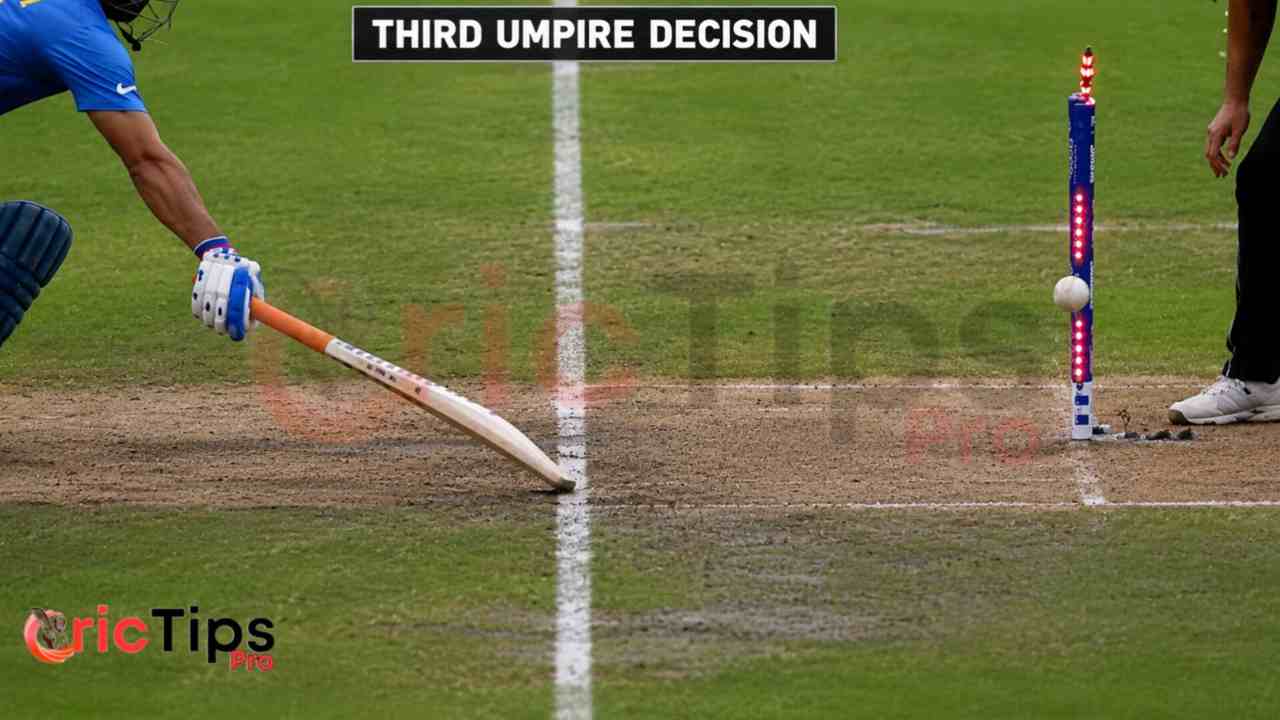
MS Dhoni was trying to take a quick run when Martin Guptill hit the stumps with a direct throw. Dhoni quickly dived toward the crease, and suddenly the whole stadium became quiet.
The umpire was not fully sure, so the decision went to the third umpire. Fans watched the replay again and again, waiting for the final result.
Then OUT appeared on the big screen.
In just a few seconds, the mood of the match completely changed. Many fans felt heartbroken because it was one of Dhoni’s last World Cup moments for India.
This is why third umpire decisions are so special in cricket.
They are not only about rules or technology. They also bring emotion, tension, and unforgettable moments that fans remember for years.
What is the Third Umpire Rule in Cricket? How DRS Changed Modern Cricket
Today’s cricket does not depend only on the umpire’s eyes. Technology also helps a lot in giving the right decision. That is why the topic What is the Third Umpire Rule in Cricket is closely connected with DRS.
DRS means Decision Review System. It allows players to ask for another check if they think the umpire’s decision is wrong. The third umpire then uses technologies like UltraEdge, Hawk-Eye, and HotSpot to see the replay clearly.
If there is doubt in a caught-behind appeal, Ultra Edge checks whether the ball touched the bat or not. For LBW decisions, Hawk-Eye shows the ball’s path and checks if it would hit the stumps.
Another important part of DRS is Umpire’s Call. Sometimes the decision is too close to change clearly. In that case, the on-field umpire’s original decision stays the same.
Because of this rule, fans often discuss and debate many decisions on social media during big matches.
Third Umpire Decision Explained: A Few Millimeters Can Change the Match
In cricket, boundary decisions and no-ball checks can sometimes be very close. That is why the third umpire has become very important in modern cricket.
Imagine a team needs just one run to win from the last ball. The batter plays a shot, but nobody is sure if the fielder touched the boundary rope or not. Then everyone in the stadium waits for the replay on the big screen.
The third umpire also checks front-foot no-balls. Sometimes a bowler crosses the line by only a few millimeters, and a wicket becomes a no-ball because of that. One small decision like this can completely change the flow of the match.
These small moments are what make cricket so emotional, exciting, and unpredictable.
What Is the Third Umpire Rule in Cricket? Why Do People Still Argue Even After Technology Came?
Technology has made cricket much fairer now. But arguments still happen because cricket is not only a game of rules it is also a game of emotions.
Sometimes UltraEdge catches a very small sound. Sometimes the camera angle is not clear enough. And many LBW decisions with “Umpire’s Call” also create debates among fans.
Still, one thing is clear technology has made cricket decisions much more accurate than before. Now viewers can watch the replay and understand how the decision was made.
And honestly, this suspense has made cricket even more exciting to watch.
What Is the Third Umpire Rule in Cricket? A Few Seconds of Replay That Change Emotions
In the end, the Third Umpire Rule is not just a technology rule. It has now become one of the most emotional and unforgettable parts of cricket.
A close run-out, a tiny edge, or an impossible catch today, many big moments depend on just a few seconds of replay. And in those few seconds, people’s emotions can completely change.
Sometimes a bowler becomes the hero. Sometimes a batter leaves the field heartbroken. And fans wait nervously for just one word “OUT” or “NOT OUT”.
Cricket has always been exciting. But the Third Umpire has made those moments even more emotional, dramatic, and unforgettable.
What is the Third Umpire Rule in Cricket?
The Third Umpire Rule in cricket allows off-field umpires to use video replays and technology to make accurate decisions during close moments like run-outs, stumpings, catches, and LBW reviews.
Why is the third umpire important in modern cricket?
The third umpire helps reduce wrong decisions and makes the game fairer. It also adds suspense and excitement because fans wait nervously for the final replay decision.
What technologies does the third umpire use in cricket?
The third umpire uses technologies like Hawk-Eye, UltraEdge, HotSpot, and slow-motion replays to check close decisions and help the on-field umpires.
Can players challenge umpire decisions in cricket?
Yes. Through the Decision Review System (DRS), players can challenge certain umpire decisions. The third umpire then reviews the incident using different camera angles and advanced technology.