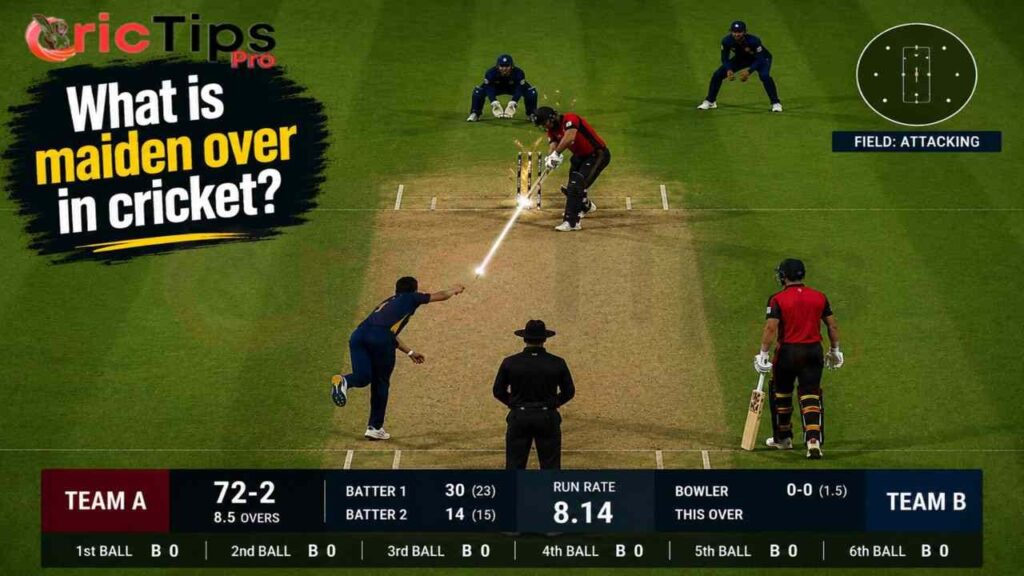
There are many moments in cricket that are not very visible on the scoreboard, but play the biggest role in determining the outcome of the match. Middle Over is just such a stage. Behind the excitement of scoring quick runs at the beginning or the thrill of the last over, these middle overs often silently change the course of the match. So naturally, the question comes to many people’s minds—What is Middle Over in Cricket?
Simply put, Middle Over is that part of the innings where both the batting and bowling teams try to implement their plans. Batters on one hand want to build an innings by holding the wicket, while bowlers on the other hand create pressure by bowling a tight line-length to block runs. This is where patience, strategy and the ability to make the right decisions are tested the most.
This is why cricket experts often say that a team lays the foundation for winning a match not only in the last over, but also in the Middle Over. In this guide, we will know in simple terms What is Middle Over in Cricket? Which overs are called Middle Over, why this stage is so important and how it can change the entire picture of a match.
Official Rules of a Maiden Over Explained
As simple as a Maiden Over may seem, its rules are as specific and subtle as it seems. Many cricket fans think that an over becomes a Maiden if the batter fails to score any runs. But in reality, the matter is much broader than that. A Wide, No Ball or any other extra run can change the score of the entire over in an instant. So the question naturally arises—what is maiden over in cricket and on what basis is an over considered a Maiden Over?
In fact, in determining a Maiden Over, it is not enough to just not allow the batter to run. Every ball of the over must be legal (Legal Delivery) and the batting team cannot score any runs throughout the entire over. This is where extras like Wide, No Ball, Bye and Leg Bye become important. Even a small mistake can deprive a bowler of a great over from becoming a Maiden.
That is why to know the correct answer to what is maiden over in cricket, it is not enough to just know the definition; it is also important to clearly understand its official rules. Below we will learn step by step under which circumstances an over is recognized as a Maiden Over, under which circumstances it is not, what is meant by Wicket Maiden, and how different types of Extras affect the outcome of an over.

How Does a Maiden Over Work?
While it is easy to understand the rules of a Maiden Over on paper, it is equally difficult to demonstrate it on the field. A bowler has to bowl six consecutive legal balls in such a perfect manner that the batter does not get a chance to score any runs. This is where the real test of patience, control and planning of a skilled bowler comes. So many cricket fans wonder—what is maiden over in cricket and how is a Maiden Over actually completed?
Let’s take a small example to understand the matter more easily. A bowler bowled six consecutive legal balls. The batter either defended or missed each ball, but could not score a single run. At the same time, the bowler did not bowl a Wide or No Ball. After the over, the scoreboard shows zero runs against the bowler. This is a complete Maiden Over. And if any wicket comes in this over, then it is called a Wicket Maiden.
A Maiden Over in cricket is not just a statistic, it is a powerful weapon to change the momentum of the match. Not getting runs on six consecutive balls puts pressure on the batsman, affects his confidence and creates a rush to play big shots in the next overs. This is the opportunity that bowlers and captains want to exploit. The whole thing will become clearer if you look at the simple examples below.
Types of Maiden Overs in Cricket
In cricket, a Maiden Over is usually an over in which the bowler does not concede any runs. But in reality, there are multiple types of Maiden Overs, and each has different importance and impact. Maiden Overs are classified in different ways based on the match situation, the bowler’s performance, and what happened in the over. So just knowing what is maiden over in cricket does not fully understand the matter; it is also important to have a clear idea about its different types.
Sometimes a simple Standard Maiden only works to prevent runs, while Wicket Maiden also stops runs and turns the tide of the match by taking important wickets. On the other hand, bowling multiple Maiden Overs in a row puts a lot of pressure on the batting team, which can force them to make mistakes. Another rare type is the Double-Wicket Maiden, where the bowler takes two wickets in the same over without conceding any runs. Such a performance can change the course of the match in an instant.
Below, we will explain each type of Maiden Over separately in simple language. The rules, features and practical impact of each will be highlighted, so that you have a complete and clear idea of what is maiden over in cricket as well as the different types of Maiden Over.
Why Is a Maiden Over So Important in Cricket?
In cricket, every run is valuable, just like every dot ball has the power to change the course of the match. And when a bowler does not concede any runs in a whole over, it is not just a good statistic but also a crucial moment that can affect the match. So, along with knowing what is maiden over in cricket, it is equally important to understand why a Maiden Over is so important.
A Maiden Over stops the batting team from scoring runs and at the same time creates mental pressure on the batter. If a run is not scored in six consecutive balls, the batter is naturally forced to take risks in the next overs. Taking advantage of this pressure, the bowler and the captain plan more aggressively, which can result in important wickets. Sometimes, a single Maiden Over can change the rhythm of the match and bring the bowling team back into the fight.
This is why a Maiden Over in cricket is not just seen as an individual achievement; it is also an effective strategy. A bowler’s perfect line-length, consistency and ability to understand the match situation are reflected through a Maiden Over. Below we will detail exactly why a Maiden Over can become one of the most important moments in a match.
Maiden Over in Test, ODI and T20 Cricket
A Maiden Over is valuable in all forms of cricket, but its importance and difficulty level are not the same in each format. From five-day Test cricket to fast-paced T20, each format has its own style of play, batting mentality and match strategy. So, along with knowing what is maiden over in cricket, it is also important to know in which format it is easiest to score a Maiden Over and in which format it is most difficult.
In Test cricket, the main goal of the batsmen is to stay at the crease for a long time. So many times they feel comfortable defending the entire over without taking any risks. As a result, Maiden Overs are relatively more common in this format. On the other hand, in ODI cricket, the number of Maiden Overs decreases due to the high pressure to score runs. And in T20 cricket, the situation is completely different. Here, runs are tried to be scored from almost every ball. As a result, it becomes difficult to maintain the consistency of even a single dot ball. That is why a Maiden Over in T20 is considered a big achievement for a bowler.
The table below will help you understand the difficulty of Maiden Over in different formats and its approximate rate.
| Cricket Format | Approx. Maiden Over Rate | Difficulty Level |
| Test Cricket | ~21.0% | Easiest – Around 1 maiden over in every 5 overs |
| ODI Cricket | ~5.9% | Moderate – Around 1 maiden over in every 17 overs |
| T20 International | ~2.4% | Very Difficult – Around 1 maiden over in every 42 overs |
| Franchise T20 (IPL, etc.) | ~0.7% | Extremely Difficult – Around 1 maiden over in every 130 overs |
These statistics make it clear that the shorter the format of cricket, the more difficult it becomes to score a maiden over. So if a bowler can score a maiden over in a fast-paced competition like T20 or IPL, it is not just a good statistic but also a testament to his exceptional bowling that can turn the tide of a match.
Famous Maiden Overs and Bowling Records
Some Maiden Overs in the history of cricket are not just a good bowling spell, but legendary moments that have been discussed for ages. For example, the name of Indian left-arm spinner Bapu Nadkarni comes first. In 1964, he set a record of 21 consecutive Maiden Overs (131 consecutive dot balls) against England, which is still one of the wonders of Test cricket. Such incidents prove that what is maiden over in cricket is not just a definition of a rule; it is a symbol of extraordinary control, patience and bowling skill.
Again, legendary Sri Lankan spinner Muttiah Muralitharan holds the record for the most maiden overs in Test cricket with 1,794. On the other hand, bowlers like Shaun Pollock in ODIs and Jasprit Bumrah in T20 Internationals have shown how valuable Maiden Overs can be in limited-overs cricket as well. Especially in an aggressive format like T20, where it is difficult to bowl a Maiden Over, Bumrah’s consistency is truly commendable. These records show that the true value of what is maiden over in cricket is clearly reflected not only on the scoreboard but also in the results of the match.
There are some other rare feats in cricket history, which make Maiden Over even more special. For example, England’s Bobby Peel bowled 56 Maiden Overs in an innings, while Canada’s Saad Bin Jaffer and New Zealand’s Lockie Ferguson created history in T20 International cricket by bowling 4 overs, 4 Maidens, 0 runs. In addition, Australia’s Glenn McGrath bowled the first Maiden Over in the history of IPL. Below, we will know in detail these extraordinary records and the feats of legendary bowlers, so that the historical importance of Maiden Over can be understood more clearly.
Tips to Bowl More Maiden Overs
A Maiden Over is never a result of luck; it takes regular practice, perfect planning and extraordinary control. Many people think that just bowling well is enough to get a Maiden Over. But in reality, a bowler has to bowl six consecutive legal balls in the same order, so that the batter does not get any chance to score runs. So, along with knowing what is maiden over in cricket, how to bowl more Maiden Overs is equally important for every bowler.
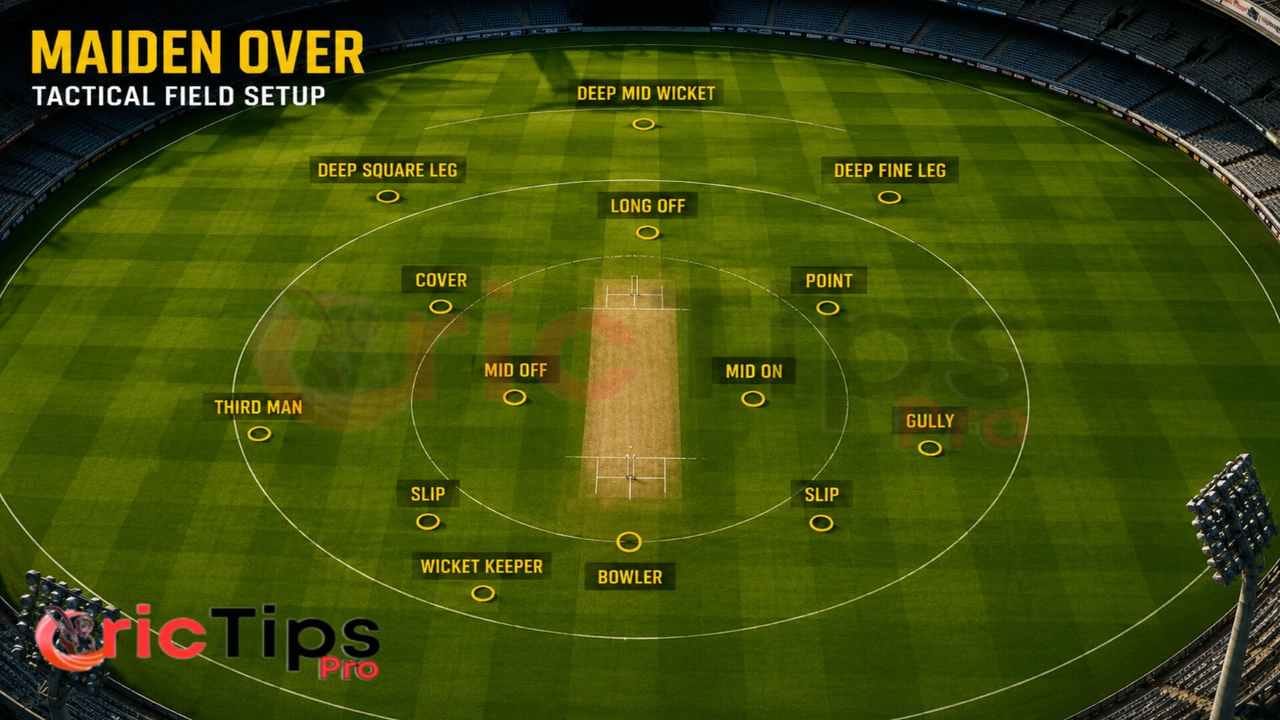
Suppose, a fast bowler is repeatedly bowling on the same line and length just outside the off stump. The batter is defending every ball, but is not getting an easy chance to take a single. On the other hand, the captain has also arranged the field in such a way that all the easy runs for the batter are closed. Such planned bowling and proper field setting gradually turn an ordinary over into a Maiden Over. The best bowlers in the world follow this very strategy and keep the batters under pressure for a long time.
In fact, the true value of what is maiden over in cricket is only realized when a bowler uses each ball as part of a separate plan. Perfect line-length, intelligent field placement, subtle changes in speed and angle, avoiding extra runs and creating consistent mental pressure on the batter these are the basics of a successful maiden over. Below are some effective tips that any bowler can follow to increase his chances of scoring more maiden overs.
Conclusion
A Maiden Over in cricket is not just a story of six dot balls; it is a reflection of a bowler’s patience, control, planning and mental fortitude. In this article, we have learned in detail about what is maiden over in cricket, the official rules, the different types, its importance in Tests, ODIs and T20s, historical records and more about effective strategies for scoring a Maiden Over. Each point shows that a Maiden Over can sometimes turn the tide of a match and can be the biggest weapon for a bowling team.
No matter how aggressive modern cricket has become, the importance of the Maiden Over has never diminished. In fact, in fast-paced formats like T20s, a Maiden Over is now more valuable than ever. So what is maiden over in cricket is not just a simple cricket question; it is a concept that, if understood, can give a deeper understanding of the bowler’s tactics, the pace of the match and the finer points of cricket.
Whether you are a new cricket fan or a long-time cricket fan, knowing the true significance of Maiden Over will enrich your cricket knowledge. I hope this guide has helped you understand the subject through simple, clear and practical examples. From now on, whenever you see a Maiden Over in a match, you will easily understand not only the zero runs on the scoreboard, but also the strategy behind it, its ability to create pressure and its match-changing impact.
What is a Maiden Over in Cricket?
A Maiden Over is an over in which the bowler concedes no runs from any legal deliveries. It is considered a sign of accurate and disciplined bowling.
Can a bowler take a wicket in a Maiden Over?
Yes. If a bowler takes one or more wickets without conceding any runs in the over, it is known as a Wicket Maiden.
Does a wide or no ball count in a Maiden Over?
No. If the bowler bowls a wide or no ball, the batting team receives an extra run, so the over cannot be recorded as a Maiden Over.
Are Maiden Overs common in T20 cricket?
No. Maiden Overs are rare in T20 cricket because batters usually attack from the very first ball, making it much harder for bowlers to concede zero runs.
Why is a Maiden Over important in cricket?
A Maiden Over builds pressure on the batting team, controls the run rate, and often creates wicket-taking opportunities, making it a valuable part of a bowling strategy.