If you want to learn cricket, it’s actually very easy to start. How can I play cricket? The first things you need are a passion for the game, some open space and a few friends. Cricket is not just a game of hitting the ball with a bat; it also involves batting, bowling, fielding and the joy of playing as a team.
You don’t need a big field or expensive cricket equipment to start. Practice in a nearby park, school ground or safe open space. Instead of three stumps, you can start at a very young age with a simple bat, a soft ball or tennis ball and a few sticks.
To start, slowly practice throwing, catching and batting with a friend. Then focus on learning the basics of bowling and fielding. Playing regularly will gradually increase your skills, build confidence and increase the enjoyment of playing cricket.
Send feedback
Understand the Basic Rules of Cricket
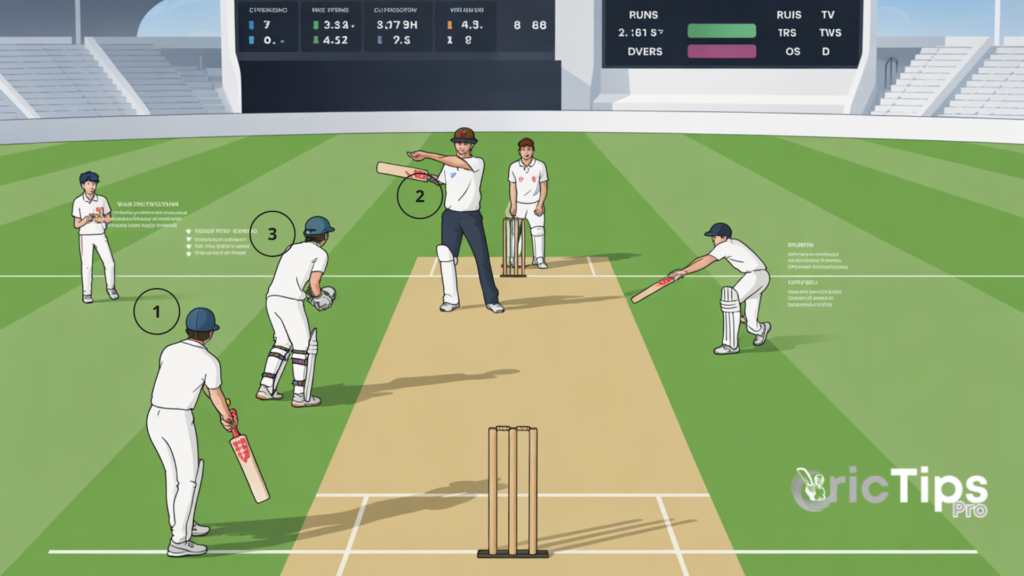
The game seems very easy if you understand the basic rules of cricket. There is no need to memorize all the rules at once in the beginning. First, you just need to understand that one team bats to score runs and the other team bowls and fields to prevent those runs and also tries to get the batters out. At the end of the match, the team that scores more runs usually wins.
A cricket team usually has 11 players. While one team bats, the other team bowls and fields. Two batters from the batting team are on the field together and try to score runs. On the other hand, the bowler bowls the ball and the fielders try to get the batters out by taking catches, stopping the ball or running them out.
Scoring Runs
The easiest way to score runs in cricket is to run between the two ends. If the batters can reach one end safely from the other end after playing the ball, 1 run is scored. The more times they can successfully change ends, the more runs will be added.
However, you don’t always have to run to score runs. If the batter hits the ball and rolls it to the ground and crosses the boundary, 4 runs are scored. And if the ball goes directly outside the boundary without hitting the ground, it is 6 runs. So it is possible to score a lot of runs quickly from a good shot.
Getting Out (Wickets)
In addition to running, another major goal of the batter is to save his wicket. If a batter is out, his batting turn is over. There are several rules for getting a batter out in cricket. Among them, Bowled, Caught, Run Out and LBW (Leg Before Wicket) are the most well-known.
Bowled is when the ball hit the stumps behind the batter. Caught is when the batter hits the ball and a fielder catches it before it hits the ground.
Run Out is when the batsman breaks the stumps with the ball before reaching the crease while scoring runs. And if certain conditions are met in LBW, the batter can be given out due to the ball hitting his leg.
Overs and Innings
In cricket, an Over consists of 6 legal balls. A bowler bowls these six balls from one end. When the over is over, another bowler bowls from the other end. This is how the bowling of the match progresses.
An Innings of a team is the period of their batting. Generally, when 10 out of 11 batsmen are out, the team’s innings ends. However, depending on the format of the match, the innings may end even after a certain number of overs have been completed.
Understanding these few things—batting, bowling, runs, wickets, overs, and innings—will lay the foundation for learning the basic rules of cricket. After that, it will be much easier to gradually learn more detailed rules.
Note: If you want to play cricket following the real rules then please do not try to cheating on the game, We know sometimes you are failed even many times but do not give up try more and be ready to prepared yourself.
Get the Right Cricket Equipment
New players can be a little confused by the amount of equipment they see when starting cricket. In fact, there is no need to buy everything at the beginning. If you want to play hard ball cricket, then a good bat, ball, batting pads, batting gloves, helmet and abdominal guard are the most important for playing safely. And if you are just playing casual cricket with friends, then you can practice with a regular bat and tennis ball in the beginning.
When buying a bat, it is better to choose a size that suits your height and build. For beginners, it may be convenient to start with a light Kashmir willow bat. In the case of the ball, you should also decide according to the type of game. A tennis ball is sufficient for general practice or casual games, but a standard cricket ball is used in hard ball cricket training.
Safety equipment should never be skipped in the case of hard ball. Batting pads protect the legs and knees from the ball hitting the ball, and batting gloves protect the fingers as well as help to keep a firm grip on the bat. A good cricket helmet is important to protect the head and face when playing against fast-paced balls.
Along with this, it is also important to use an abdominal guard or box, especially in hard ball cricket. It is used to protect the sensitive parts of the body from direct hits of the ball. Therefore, the equipment should be selected with safety in mind from the very beginning.
However, not all equipment needs to be purchased on the first day. If you start playing regularly or join a formal cricket team, you can gradually acquire additional items like thigh guards, arm guards, specialized cricket shoes and kit bags. It is possible to practice with ordinary sports shoes in the beginning, although cricket shoes can be more advantageous if you play regularly in the field.
The most important thing is to give importance to size, comfort, protection and quality while buying equipment, not just looking at the price or looks. With the right equipment, a beginner can practice safely and gradually improve his cricket skills.
Learn the Basics of Batting
Learn the Basics of Batting
How Can I Play Cricket—To find the answer to this question, it is important to learn the basics of batting. Hold the bat with both hands, but do not over-tighten the grip. Place your upper hand on top of the handle and your lower hand just below it. The “V” shape between the thumb and index finger should be straight with the back of the bat. Stand slightly sideways towards the bowler and keep your feet shoulder-width apart. Keep your knees slightly bent to maintain balance and keep your head still and your eyes on the ball.
It is very important to do your footwork at the right time after bowling the ball. If the ball is coming in front of you, try to approach the ball with your front foot. And if it is a short-pitched ball, move back and adjust your body to the ball. To start with, practice blocking the ball with a straight bat to protect your wicket. Keeping the face of the bat straight and lowering the ball towards the ground makes it easy to defend.
Then, you can gradually learn basic attacking shots. If you extend your front foot and drive the ball, you can play a drive. And against a ball that bounces backwards, you can play a pull or cut shot. Keep your head on the ball and maintain wrist control when playing any shot. This makes it easier to land the shot and reduces the risk of the ball going up in the air unnecessarily.
Learn Bowling and Fielding Basics
Both bowling and fielding are important in learning the basic skills of cricket. In Bowling Basics, you first need to focus on the correct grip, run-up and line and length. Hold the ball on the seam with your index finger and middle finger and support it with your thumb below. Keeping a little space between the palm and the ball makes it easier to control the grip.
The run-up should be natural and controlled. Start slowly and increase the speed as you move towards the crease. Keep your aim fixed the entire time and bowl. Then practice fixing the line and length. First fix the target where you want to throw the ball. The main thing is to bowl directly towards the stumps or to throw the ball at a specific place outside the off-stump.
In fielding, some basic skills also need to be practiced regularly. While catching, keep your full attention on the ball and do not take your eyes off it until it is in your hand. In case of high catch, make your hand with your fingers pointing upwards, and in case of low catch, keep your fingers pointing downwards. Taking your hand slightly back when you get the ball in your hand reduces the impact of the catch.
It is important to set your body correctly towards the target while throwing. Keep your body slightly sideways and keep your non-throwing shoulder towards the target. Then, swing your hand over your shoulder and throw the ball in a controlled manner.
While ground fielding, keep your body low in front of the ball. Bend your knees and grab the ball with both hands as if you are scooping it and keep your body just behind the ball. After getting the ball in your hand clearly, prepare yourself to throw quickly. Practicing these basic skills regularly will gradually increase your control in both bowling and fielding.
How to Practice Cricket as a Beginner
How Can I Play Cricket—The answer to this question is not limited to knowing the rules of cricket. To play well, regular practice is also important. For a beginner, the practice routine does not need to be very difficult. Warm up your body with light jogging and stretching for 10–15 minutes. Then practice batting or bowling action without the ball for a while. After practice, bring your body back to normal by walking slowly and stretching lightly.
Start batting practice by fixing your grip and stance. Keep your feet shoulder-width apart, stand with your knees slightly bent and keep your eyes on the ball. Then you can practice wall ball with a tennis ball. You can practice straight bat swing and timing by hitting the ball against the wall. If you have a friend, ask him to toss the ball slowly and try to play the shot at the right time by keeping the ball under your eyes.
Pay attention to grip and run-up during bowling practice. Hold the ball by placing your index and middle fingers on the seam and use a simple and consistent run-up of 3–5 steps at the beginning. You can do target bowling by placing a cone or towel on the pitch. It is more important to maintain smooth action, balance and follow-through rather than trying to hit the ball hard at the beginning.
When learning to catch, practice with a simple tennis ball first. A partner can throw the ball from close by, so that the hand reaction is faster. If you move your hand back slightly when the ball is in your hand, the impact is reduced and the catch is under control. Then practice high catches and do not take your eyes off the ball until it is in your hand.
You can also do some simple exercises to improve hand-eye coordination. Catching a tennis ball by bouncing it on the ground with one hand, hitting the ball against the wall with one hand and releasing it with the other hand, or juggling with two or three balls is good practice. Doing these small drills regularly will gradually improve ball tracking, timing and reaction.
Improve Your Cricket Fitness and Skills
You cannot become a complete cricketer by just practicing with bat and ball. To do well in cricket, you need to keep your body ready to handle the pressure of the match along with your skills. Batting for a long time, bowling one over after another or running fast on the field to stop the ball—everything requires cricket fitness.
Running and stamina are very important for a cricketer. Having good stamina makes it easier to keep your body and mind fresh even after batting or bowling for a long time. At the same time, if you can run fast, it is possible to turn one run into two runs between the wickets and reach the ball quickly while fielding.
Along with this, having agility and flexibility is also important. Good body movement is required when changing direction suddenly on the field, blocking the boundary with a dive or throwing the ball quickly. Flexibility helps the body move naturally and can also reduce the risk of unnecessary strain during practice or matches.
Reaction speed also makes a big difference in cricket. A close catch, a fast ball or a sudden shot towards the body requires a decision to be made within a few moments. Regular fitness practice has a positive effect on strength, movement and concentration, which helps in maintaining one’s performance even towards the end of the match.
Therefore, along with batting and bowling practice, one should also work regularly on running, stamina, agility, flexibility and reaction speed. The better prepared the body is, the longer a cricketer will be able to use his technical skills effectively.
Common Mistakes Beginners Should Avoid
How Can I Play Cricket—When looking for the answer to this question, it is important not only to know what to do, but also to know which mistakes to avoid. New players make some common technical mistakes at the beginning, which can later become habits. So it is important to get the basics right from the start.
One of the most common mistakes is not watching the ball properly. Many beginners pay more attention to the bowler or the pitch, but do not follow the ball the entire time after it leaves the bowler’s hand. Keeping your eyes on the ball until it comes to the bat makes it easier to improve timing and reduce the risk of losing wickets unnecessarily.
Another mistake is holding the bat too tightly. An excessively tight grip reduces the natural movement of the wrist and destroys shot control. The top hand will control the bat, and keeping the bottom hand relatively relaxed allows for more natural bat movement.
Lack of footwork is also a big problem for beginners. If you try to play every ball from one place, it is difficult to reach the correct position. It is necessary to develop the habit of moving your feet forward or backward according to the line and length of the ball. If you do not move, you will often make a wrong shot while reaching the ball.
Trying to play big shots in the beginning is also risky. It is better to take time to understand the speed, bounce and pitch of the ball before trying to hit the boundary with the first few balls. Playing solid defensive strokes in the beginning gives you the opportunity to develop your timing and control.
Finally, inconsistent practice creates obstacles in the way of improvement. It is more effective to drill regularly for a short time every day than to do one long practice session every few weeks. Batting stance, timing and muscle memory are gradually developed through regular repetition.
Conclusion
The path to learning cricket becomes easier as you progress step by step. First, understand the rules, then practice the basic skills of batting, bowling and fielding with the necessary equipment. If you pay attention to fitness along with regular practice, you can gradually improve your game.
Things like running, stamina, agility and reaction speed help a cricketer perform better on the field. Then, if you get the opportunity, you can join a cricket club and get experience playing regularly with other players.
Ultimately, the answer to How Can I Play Cricket is very simple—learn, practice regularly and try to improve yourself from mistakes. If you maintain your interest in cricket and move forward, a beginner can gradually make a place for himself.
How Can I Play Cricket as a Beginner?
Start by learning the basic rules, then practice batting, bowling and fielding regularly. Joining a cricket club can also help you learn faster.
What Equipment Do I Need to Start Playing Cricket?
A beginner generally needs a cricket bat, ball, batting gloves, pads, helmet and suitable cricket shoes. The exact equipment depends on the type of cricket you play.
How Long Does It Take to Learn Cricket?
You can learn the basic rules and skills within a few weeks with regular practice. Becoming a confident player takes more time, experience and match practice.
Can I Learn Cricket Without Joining a Cricket Academy?
Yes. You can learn basic cricket skills through self-practice, videos and playing with friends. However, a coach can help correct technique and improve your progress.
What Should a Beginner Practice First in Cricket?
Start with basic batting stance, bat grip, defence, catching, throwing and simple bowling. Once these skills improve, gradually move on to advanced techniques and match practice.