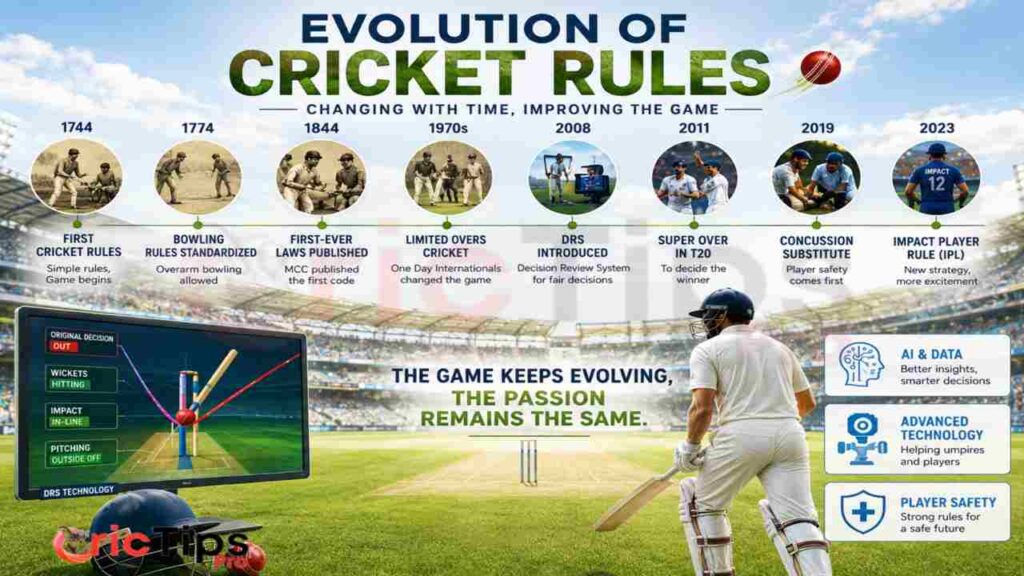
Cricket rules have changed a lot over time and have given the game a modern look. Cricket is not only about bat and ball. Different rules have made the game more organized, exciting and modern.
Today’s cricket was not the same in the beginning. There was no DRS, no T20 format and no Powerplay. As time passed, many rules were added and changed. These changes have brought new ideas to the game and made cricket more competitive and popular among fans.
The history of cricket rules is actually the history of cricket’s development over many centuries. For more than 300 years, many rules have changed. Some rules were introduced to help batters, some to create balance for bowlers and some to improve player safety. These changes have helped cricket become one of the most popular sports in the world today.
1744 to 1864: Building the Foundation of Cricket
The use of technology in today’s cricket is the result of many rule changes over time.
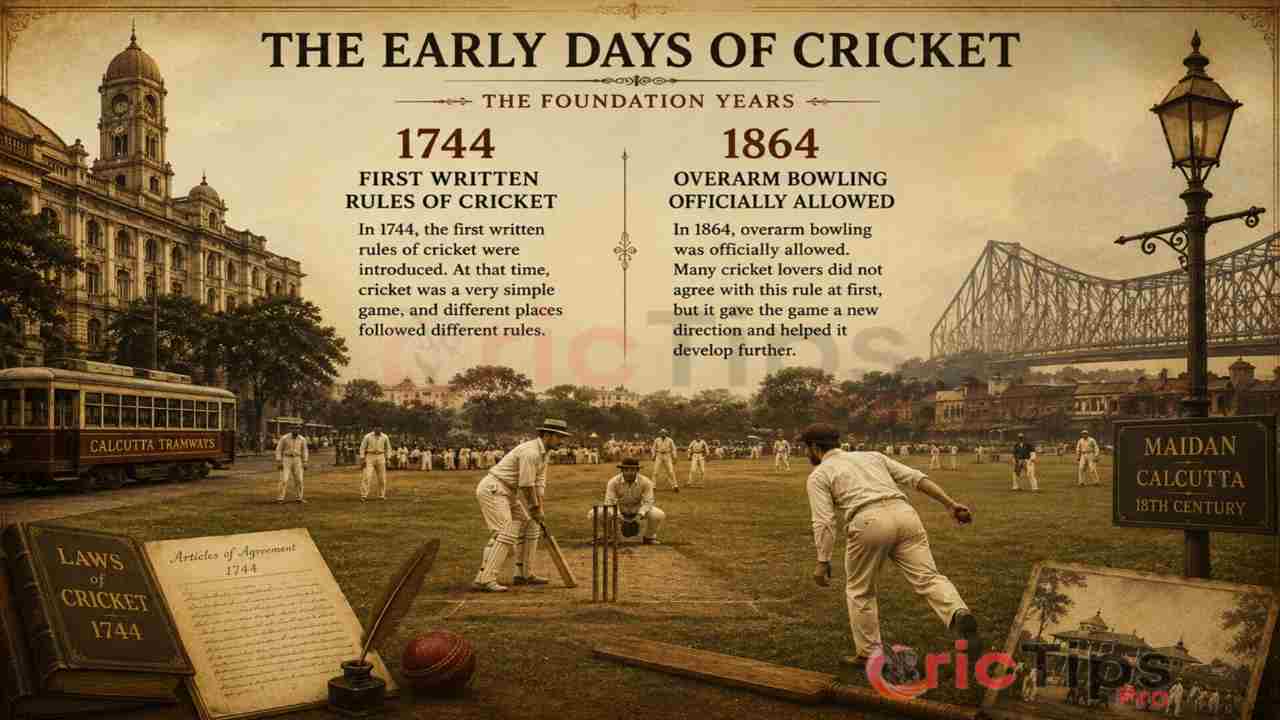
In 1744, the first written rules of cricket were introduced. At that time, cricket was a very simple game, and different places followed different rules.
In 1774, the LBW (Leg Before Wicket) rule was introduced. Before this rule, batters could stop the ball with their legs to protect the wicket. The new rule stopped this unfair advantage.
In 1864, another major change came to cricket when overarm bowling was officially allowed. Many cricket lovers did not agree with this rule at first, but this change gave cricket a new direction and helped the game develop further.
Limited-Overs Cricket
One of the biggest changes in the history of Evolution of Cricket Rules was the introduction of limited-overs cricket.
In the early days, five-day Test matches were not equally attractive to all fans. So, in England, limited-overs cricket was introduced in 1963.
Later, in 1971, the first One Day International (ODI) match was played. As its popularity increased, the first ODI World Cup was held in 1975.
The ODI format encouraged batters to score runs faster. Fielding became more important, and the game became more exciting and entertaining for fans around the world.
T20 Cricket and DRS: A New Era in Cricket
In 2003, the England and Wales Cricket Board (ECB) introduced T20 cricket. At first, many people thought it was only an experiment, but within a short time, T20 became one of the most popular formats in the world.
The Impact of T20 Cricket
A 20 over match made cricket faster, more exciting and more entertaining for fans. It also led to the creation of famous leagues such as IPL, BBL, PSL and SA20. These tournaments have become an important part of modern cricket and attract millions of viewers every year.
Decision Review System (DRS)
The Decision Review System (DRS) was introduced to help make umpiring decisions more accurate. It uses modern technology to reduce mistakes during a match. DRS was first used in international cricket in 2008, and today it is an essential part of the Evolution of Cricket Rules.
One example of how DRS works was seen during the 2022 World Cup final. Sometimes, an on-field umpire may give an LBW decision, but after a review, it can be changed if the technology shows a different result.
This proves that the Evolution of Cricket Rules is not only about creating new rules. It is also about making fair and accurate decisions with the help of modern technology.
Free Hit
In 2009, the ICC introduced the Free Hit rule. During a Free Hit, a batter cannot be dismissed in most normal ways, so they can play more attacking shots without much risk.
This rule has made the game more exciting and has increased entertainment for cricket fans around the world.
Super Over and Concussion Substitute
Sometimes, a cricket match ends in a tie, and it is difficult to decide a winner. In this situation, a Super Over is used to determine the winning team. Each team gets one extra over to score more runs than the other team. A famous example was the 2019 Cricket World Cup final, where the match was decided through a Super Over.
Player safety is also an important part of modern cricket. In 2019, the ICC introduced the Concussion Substitute rule. If a player suffers a head injury during a match, another player with similar skills can replace them. This rule helps protect players and allows teams to continue playing fairly while keeping player safety as the top priority.
Impact Player
The IPL introduced the Impact Player rule in 2023. This rule allows a team to replace one player during a match based on the situation. It gives teams more flexibility and helps them change their strategy during the game.
Impact of the Rule
This rule has made match strategies more complex and interesting. Many cricket experts believe that similar rules may also be used in international cricket in the future.
The Future of Cricket
In the future, cricket may become even more advanced with improved DRS, AI-based decision-making and new technologies. The Evolution of Cricket Rules will continue as the game changes with time and modern technology.
Conclusion
From the first cricket rules in 1744 to modern rules like DRS, Super Over, Concussion Substitute and Impact Player, every change has brought something new to the game.
These new rules have changed the way cricket is played and have made it more exciting for people around the world.The Evolution of Cricket Rules is not just about adding new rules. It is a story of cricket’s growth, innovation and continuous improvement over time.
What is the Evolution of Cricket Rules?
The Evolution of Cricket Rules refers to the changes and improvements made to cricket laws over time to make the game fairer, safer and more exciting for players and fans.
When were the first official cricket rules introduced?
The first written Laws of Cricket were introduced in 1744, providing a standardized set of rules for the game.
What is the role of DRS in modern cricket?
The Decision Review System (DRS) helps umpires make more accurate decisions by using technologies such as ball tracking and UltraEdge.
How has T20 cricket influenced the Evolution of Cricket Rules?
T20 cricket introduced faster gameplay, innovative strategies and new regulations, helping cricket become more entertaining and globally popular.