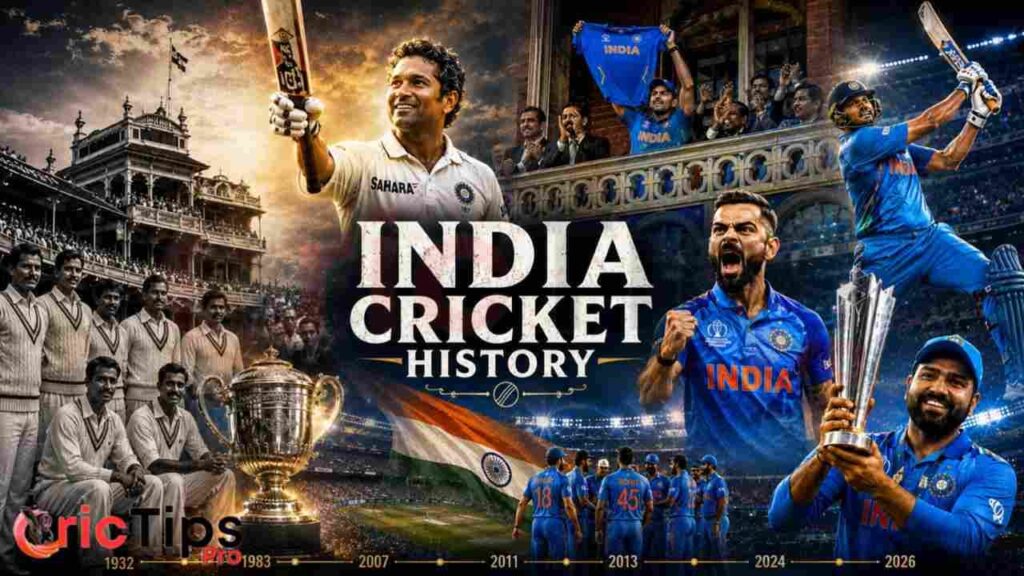
India Cricket History is not just the history of cricket, it is an extraordinary story of India’s social transformation, national self-confidence and rise to the world stage. Although cricket was introduced in India by the British in the 18th century, over time it has become the most popular sport in the country. Today, India Cricket is not only the passion of millions of fans, but also one of the most influential forces in world cricket. And at the center of that journey is the BCCI, which is currently one of the strongest and richest cricket boards in international cricket.
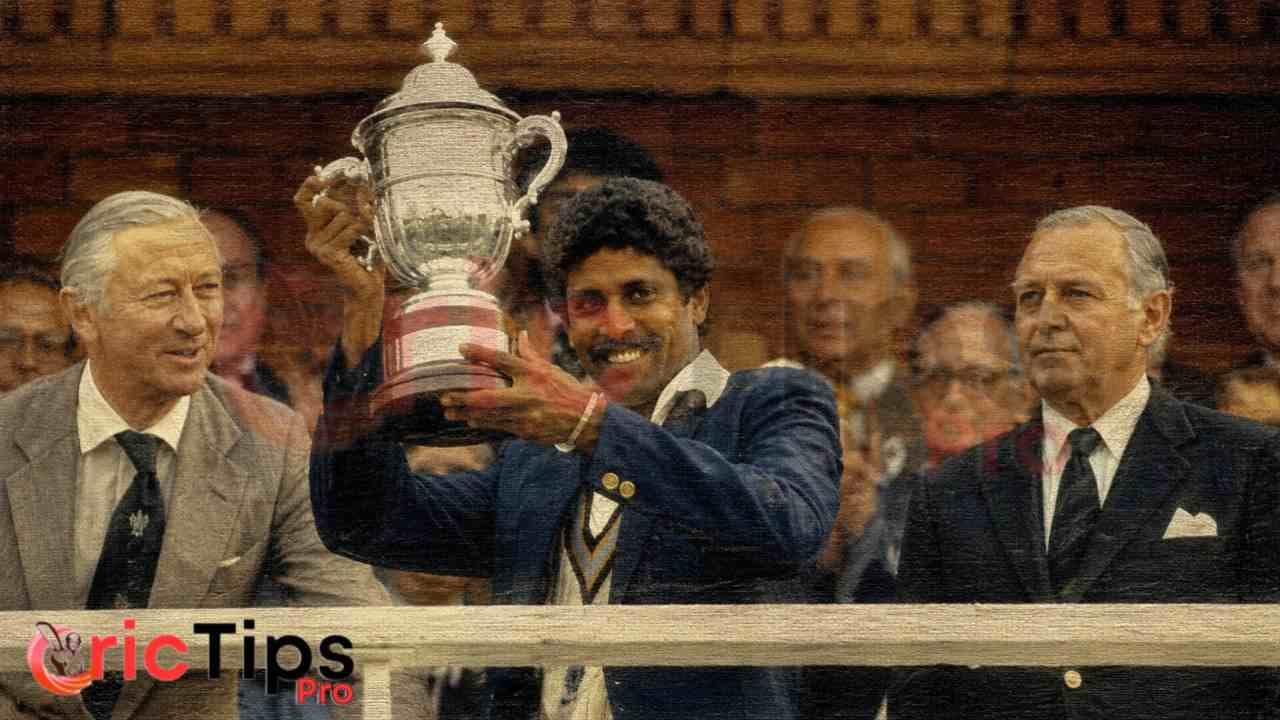
However, the path to reaching this position was not easy at all. India made its debut in Test cricket for the first time in 1932. In the first few decades, India had to go through a difficult struggle. It had to prove itself against the powerful England, Australia and the West Indies continuously. That long wait ended on June 25, 1983, when India, led by Kapil Dev, defeated the then world champions West Indies at Lord’s to win the World Cup for the first time. This one victory changed the course of not only Indian cricket, but the entire country’s sporting history.
After that, Indian Cricket never looked back. Sachin Tendulkar’s batting magic, Sourav Ganguly‘s aggressive leadership, the world cup under Mahendra Singh Dhoni, Virat Kohli’s consistency and the introduction of the IPL in 2008 brought India to the new center of world cricket. Apart from its success on the field, India has also set new standards in world cricket in terms of economy, technology, broadcasting and commercial aspects.
In this India Cricket History article, we will highlight every important chapter of Indian cricket in a row. The arrival of cricket during the British era, the first Indian cricket club, the Test debut in 1932, the development of the national team after independence, the historic victory in the 1983 World Cup, the contribution of legendary cricketers, the birth of the IPL, multiple ICC titles and the global dominance of India Cricket in the modern era – everything will be discussed in detail with reliable information and historical context. As a result, this article will serve as a complete and reliable guide for any reader interested in knowing the history of Indian cricket.
The Origin of Cricket in India
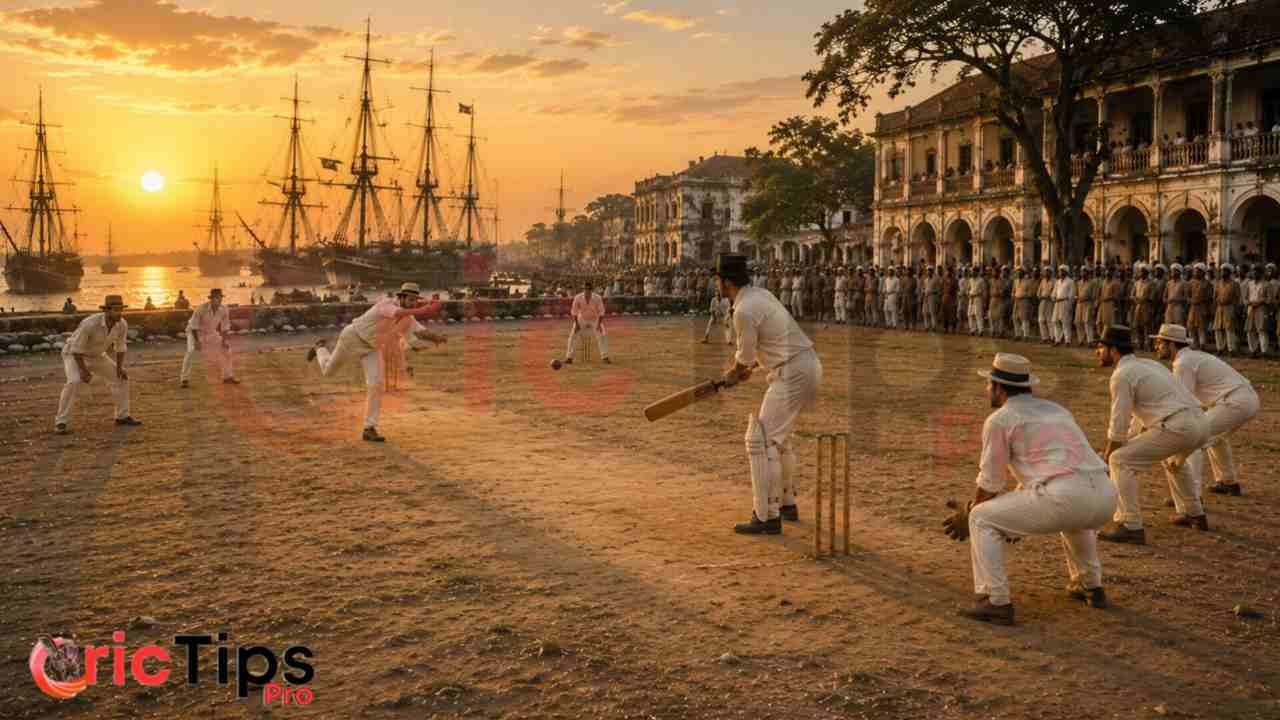
India Cricket History began in 1721, when sailors of the British East India Company played a cricket match at the port of Khambhat (then Cambay) in Gujarat. Sailor Clement Downing mentioned this match in his travelogue published in 1737, which is recognized as the first written historical evidence of cricket being played in the Indian subcontinent. Although cricket was a leisure activity for the British at that time, over the next two centuries, the game became the most popular sport in India.
This journey of cricket was slow but steady. With the expansion of British trade, the game also spread to different parts of India. Initially, it was limited to only European officials and soldiers. However, over time, people from different strata of Indian society became interested in cricket and gradually made the game a part of their culture.
Today, India Cricket symbolizes the strongest cricket system in the world. But the foundation of that dominance was laid centuries earlier, when a colonial game gradually became part of the identity, passion and national pride of Indians. So India Cricket History is not just the story of the evolution of a game; it is also the history of the rise of a nation.
How Cricket Came to India
The arrival of cricket in India is directly related to the commercial expansion of the British East India Company. After the establishment of the company’s main commercial centers in Madras (now Chennai), Bombay (now Mumbai) and Calcutta in the 17th and 18th centuries, British sailors, soldiers, merchants and administrative officials working there started playing cricket in their spare time. These coastal cities later became known as the first cricket centers in India.
A match played between British soldiers and European settlers in 1751 is considered the first officially recorded cricket match in India. Although ordinary Indians did not have the opportunity to participate in the game at that time, cricket’s popularity gradually spread to local society.
In this way, a foreign game came to the center of Indian interest. Later, with the patronage of various communities, educational institutions and royal families, India Cricket acquired a new identity and the foundation of Indian cricket became stronger.
Impact of British Rule
During the British rule, cricket was not just a game; it was also a symbol of social status, cultural influence and administrative relations. Although the British presented their lifestyle and values through cricket, many Indian kings, landlords and aristocratic families adopted the game as a means of building good relations with the British administration. As a result, cricket quickly gained popularity in the upper class society.
When cricket started being played regularly in various military camps and cantonments of the country in the 19th century, the organizational basis of the game became stronger. Later, Parsi, Hindu, Muslim and Sikh communities formed their own clubs and started participating in competitions. As a result, historic competitions like the Bombay Quadrangular and later the Pentangular Tournament were born.
These competitions played an important role in the development of Indian cricket. Because it was here that Indian cricketers got the opportunity to play regular competitive matches, which later helped to build the foundation of the national team.
First Cricket Club and Beginning of Domestic Cricket
Organized cricket in India began with the establishment of cricket clubs. The Calcutta Cricket Club, founded in 1792, was the first cricket club in India and the second oldest cricket club in the world. Although it was initially run only for the British, cricket gradually gained popularity among Indians as well.
In 1848, the Parsi community of Bombay founded the Oriental Cricket Club, which was the first cricket club run by Indians. Later, the Young Zoroastrian Club, Hindu Gymkhana and several other local clubs were established. These clubs gave Indian cricketers an opportunity to compete against European teams and played an important role in the development of Indian cricket.
Domestic cricket in India became more organized with the formation of regional cricket associations in the late 1920s. This led to the start of the Ranji Trophy in the 1934–35 season, which is still India’s most prestigious first-class domestic cricket tournament. The emergence of many legendary Indian cricketers in international cricket has come from this tournament, which is considered the backbone of India Cricket.
History of the Establishment of BCCI
The need to manage Indian cricket under a central structure became clear in the 1920s. In 1926, two representatives of the Calcutta Cricket Club attended the Imperial Cricket Conference (now ICC) meeting held in London. After that meeting, the Marylebone Cricket Club (MCC) tour to India proved to the international community that India was capable enough to organize and manage international cricket.
Then in 1927, R.E. Grant Govan and Anthony de Mello organized a meeting of representatives of various regional cricket associations at the Roshnara Club in Delhi. There, it was unanimously decided to form a national cricket board, so that India could gain formal recognition in international cricket.
Finally, on 1 December 1928, the Board of Control for Cricket in India was officially established in Mumbai.
India’s International Debut (1932–1959)
The international chapter of India Cricket History began on 25 June 1932. On that day, India made its debut as the sixth Test-playing nation in the world by playing its first Test match against England at the historic Lord’s Cricket Ground in London. The official captain of the tour was the Maharaja of Porbandar, but C. K. Nayudu was given the responsibility of leading the team based on his cricketing ability. Through this, he made his name in history as India’s first Test captain. That match marked the beginning of India Cricket’s international journey.
India showed their mettle in their debut match. Mohammad Nissar, with the new ball, put England’s strong batting lineup under pressure and took the first five wickets in India’s Test history with bowling figures of 5/93. His brilliant spell saw England fall to 19/3. Although England eventually won by 158 runs, India showed promise by scoring 189 and 187 in their two innings.
But as promising as the beginning was, the road ahead was as difficult as it was. India played 24 consecutive Tests from 1932 to early 1952, but failed to win. World War II (1939–1945), the freedom movement and the partition of India in 1947 had a major impact on the progress of Indian cricket. Team restructuring, shortage of players and lack of international experience all had to go through difficult times. But it was during this time that the foundation of India Cricket History became stronger.
Finally, on 10 February 1952, the wait was over. India tasted its first Test victory by defeating England by an innings and 8 runs at the Chepauk Stadium in Chennai. Led by captain Vijay Hazare, India declared 457/9 in the first innings. Pankaj Roy scored 111 runs, and Polly Umrigar played an unbeaten 130 runs. The hero of the match was Vinoo Mankad, who took 12 wickets in two innings to lay the foundation for victory.
India achieved another major success towards the end of the same year. India won a Test series for the first time by defeating Pakistan 2-1 on home soil. These two achievements boosted India Cricket’s confidence in international cricket and showed the world that India was no longer just a new team, but was on its way to becoming a strong contender.
India Cricket History during this period was shaped by some extraordinary pioneer cricketers. C. K. Nayudu set new examples of leadership, Mohammad Nissar and Amar Singh challenged the opposition with the new ball. Vijay Merchant was praised for his perfect batting technique, and Lala Amarnath created new history by scoring India’s first Test century. Later, Vijay Hazare, Vinoo Mankad and Polly Umrigar put Indian cricket on a stronger footing with consistent performances. Their contributions laid the foundation for the rise of India Cricket in the next decade.
The Rise of Indian Cricket (1960s–1982)
The period from the 1960s to 1982 is one of the most important chapters in the history of Indian Cricket. During this period, Indian Cricket gradually transformed from an erratic team to a confident and competitive team. The mentality of fighting against strong opponents, improved leadership and consistent performances gave Indian cricket a new identity. It was during this period that the foundation for winning the 1983 World Cup began to be laid.
A new era began in Indian cricket after Mansoor Ali Khan Pataudi (Tiger Pataudi) became the captain in 1962. He understood that India’s biggest strength was spin bowling. So the team’s strategy was arranged accordingly. Along with this, he also emphasized on improving the quality of fielding and instilled confidence and a positive mindset among the cricketers.
India’s biggest weapon during this period was the legendary Spin Quartet. Erapalli Prasanna, Srinivas Venkataraghavan, Bhagwat Chandrasekhar and Bishan Singh Bedi—these four spinners collectively took 853 wickets in Test cricket. Their unique bowling style posed a major challenge to the opposing batsmen and spin bowling became the mainstay of Indian Cricket’s success.
Sunil Gavaskar’s debut in 1971 marked the beginning of a new era in Indian cricket. He stunned the cricketing world by scoring 774 runs in his first Test series against the West Indies. His impeccable technique, patience and consistent batting brought stability to India’s top order. His performance against one of the most formidable pace attacks in the world at that time is still considered one of the best debut series in Test history.
The same year, under the leadership of captain Ajit Wadekar, India won a Test series for the first time in the West Indies. A few months later, India also won a historic series 1–0 on a tour of England. Bhagwat Chandrasekhar’s 6/38 at The Oval is one of the most memorable moments of that victory. These two series victories proved that Indian Cricket had acquired the ability to win not only at home but also abroad.
From the late 1970s to 1982, India continued to improve. Tough overseas tours, including Australia, brought important Test victories and increased confidence as a team. The leadership, spin bowling and strong batting unit of this period combined to create a foundation in India Cricket History, on which India went on to win the World Cup the following year, which changed the course of world cricket.
The Historic 1983 World Cup Revolution
The biggest turning point in India Cricket History came in 1983. By winning the World Cup at Lord’s, India not only won a trophy, but also changed the history of world cricket. Till then, no one considered India as a major force in limited-overs cricket. The team, which had won just one match in the 1975 and 1979 World Cups, made the impossible possible in 1983. After this success, India Cricket gradually started to transform from a game into the biggest passion of the country and a future commercial force.
At the center of this revolution was captain Kapil Dev. His leadership was a symbol of confidence, courage and a positive mindset. He made the cricketers believe that no matter how strong the opponent, India can win. His attacking mentality transformed the entire team and that team later became immortalized in cricket history as “Kapil’s Devils”. India’s biggest strength in that World Cup was the unity of the team, confidence and the mentality of fighting till the end.
On 18 June 1983, India were in great danger at 17/5 in a group match against Zimbabwe. At that moment, Kapil Dev played one of the greatest innings in the history of ODI cricket. He single-handedly changed the course of the match by scoring 175 not out off just 138 balls. The innings contained 16 fours and 6 sixes. His unbroken 126-run partnership with Syed Kirmani gave India a total of 266/8, which eventually turned into a 31-run victory. This innings completely changed the confidence of the Indian team. Notably, no video of this history-making innings was recorded due to the BBC strike.
On 25 June 1983, India faced the two-time world champions West Indies in the final at Lord’s. Clive Lloyd’s team entered the field with the aim of a third consecutive title, but India fought back from the start. Batting first, India were all out for just 183 runs. Kris Srikkanth scored the team’s highest score of 38 runs. Many thought the match would be easy for the West Indies as the target was small.
But the turning point of the match came with the wicket of Viv Richards. Kapil Dev took a brilliant catch of about 20 yards in the mid-wicket region off Madan Lal, which is still considered one of the most iconic moments in World Cup history. After that wicket, the Indian bowlers took complete control of the match. With the brilliant bowling of Mohinder Amarnath (3/12) and Madan Lal (3/31), the West Indies were all out for just 140 runs. That historic victory by 43 runs ensured India’s first World Cup title and began a new era in Indian Cricket History.
This World Cup victory in 1983 not only changed the outcome of a tournament, but also changed the future of Indian cricket. After this victory, cricket became more popular in every city, town and village of the country. Sponsorships, television broadcasting and corporate investment began to increase. Later, India won the right to host the 1987 World Cup, which was held outside England for the first time. This success inspired countless cricketers of the next generation, including Sachin Tendulkar. Therefore, the 1983 World Cup victory is still regarded with utmost importance as the foundation of today’s strong Indian Cricket and the biggest turning point in modern Indian Cricket History.
The Sachin Tendulkar Era and the 1990s
The 1990s were one of the most important periods in Indian Cricket History. During this period, Indian Cricket advanced not only in terms of field play but also in terms of popularity, viewership and influence in world cricket. The arrival of some new star cricketers and memorable moments in big matches gave Indian cricket a new identity.
The biggest name of this period was Sachin Tendulkar. At the age of just 16, he made his international debut against Pakistan in 1989. In front of him were the best pace bowlers in the world like Imran Khan, Wasim Akram and Waqar Younis. Even after being hit in the face by the ball, he did not leave the field. That courage and confidence later made him one of the best batsmen in the world.
After entering ODI cricket as an opening batsman in 1994, Sachin Tendulkar’s career changed. He used to put pressure on the opponent by batting aggressively from the start. His famous “Desert Storm” innings against Australia in Sharjah in 1998 is still considered one of the greatest innings in cricket history. With his success, the popularity of Indian Cricket also grew rapidly.
At the same time, Mohammad Azharuddin played a crucial role as the captain of the Indian team. Under his leadership, India defeated many big teams at home. He gave opportunities to young cricketers and helped establish future stars like Sourav Ganguly, Rahul Dravid, Anil Kumble and Javagal Srinath in the team. Although his career was later ended in a match-fixing controversy, his contribution to the development of Indian cricket was significant.
The 1996 ICC Cricket World Cup was a memorable tournament for Indian cricket. India’s victory over Pakistan in the quarter-finals is still a special moment for fans. Venkatesh Prasad’s brilliant bowling and Ajay Jadeja’s stormy batting made that match one of the best battles of the World Cup.
However, India’s journey ended in disappointment against Sri Lanka in the semi-finals. India’s batting collapsed after Sachin Tendulkar was dismissed. Later, the match was abandoned due to crowd chaos and Sri Lanka was declared the winner. Vinod Kambli’s tears as he left the field still remind us of the pain of that defeat.
Although the 1996 World Cup was not won, the popularity of India Cricket increased after this tournament. The number of people watching cricket on television increased, big companies joined as sponsors and cricket became the most popular sport in the country. Building on the strong foundation created during this time, India Cricket History moved forward on a new path of success under the leadership of Sourav Ganguly and MS Dhoni in the following years.
The Sourav Ganguly Era – Building a Fearless Team
The period from 2000 to 2005 is one of the most important chapters in Indian Cricket History. During this period, Sourav Ganguly was not just a captain, he changed the mentality of Indian cricket. Under his leadership, India Cricket learned to fight from a strong team at home to fight abroad. It was during this period that a team was formed, which laid the foundation for the success of Indian cricket for the next decade.
After the match-fixing scandal of 2000, Indian cricket faced a major crisis. The faith of the fans was lost, and the atmosphere in the team was also uncertain. It was at this time that Sourav Ganguly took over as captain. His first goal was to restore the confidence of the team. Along with the new coach John Wright, he created discipline, unity and a professional atmosphere in the dressing room. He started building a strong team by utilizing the experience of senior cricketers Sachin Tendulkar, Rahul Dravid, Anil Kumble and VVS Laxman.
Sourav Ganguly’s greatest strength was finding young talent and trusting them. Under his leadership, Virender Sehwag found a new identity as an opener in Test cricket and carved a separate place in world cricket with his aggressive batting. At the same time, young cricketers like Yuvraj Singh, Harbhajan Singh and Zaheer Khan got regular opportunities. Later, all four of these players became match-winning cricketers for the Indian team and became the face of a new era in Indian Cricket.
The 2001 Eden Gardens Test is still remembered as one of the greatest Test matches in Indian Cricket History. Steve Warr had brought Australia to Kolkata after winning 16 consecutive Tests. India had to follow-on after falling behind in the first innings. From there, an incredible comeback began. The historic partnership of 281 runs by VVS Laxman and 180 runs by Rahul Dravid turned the match around. On the other hand, Harbhajan Singh took 13 wickets in the match and also took India’s first Test hat-trick. In the end, India won by 171 runs, creating one of the greatest comebacks in cricket history.
The 2003 ICC Cricket World Cup was a big test for the team built by Sourav Ganguly. Despite facing initial setbacks, India reached the final by winning eight consecutive matches. The performances of Sachin Tendulkar, Rahul Dravid, Yuvraj Singh, Zaheer Khan and Ashish Nehra gave India confidence throughout the tournament. Although they lost to Ricky Ponting’s Australia in the final in Johannesburg, that World Cup made India one of the strongest teams in world cricket again.
Today, Sourav Ganguly’s time is remembered not only for its success, but also for developing a new mentality. He taught Indian cricketers that they need to have the confidence to win on any field in the world. Building on the team and culture he created, India later achieved historic successes in the 2007 T20 World Cup, 2011 World Cup and many more under the leadership of MS Dhoni. Therefore, Sourav Ganguly’s contribution in laying the foundation of the modern era of Indian Cricket is still unique.
The MS Dhoni Era – India’s Golden Generation
The period under MS Dhoni’s leadership is considered by many to be the golden era of Indian Cricket History. Under his captaincy, India Cricket not only won trophies, but also carved out a distinct identity for itself in world cricket. He became known as “Captain Cool” due to his calm demeanor, cool-headed decisions and the right planning in difficult moments. Even today, he is the only captain to have won three major ICC white-ball trophies.
The first ICC T20 World Cup in 2007 was Dhoni’s first big test as captain. Despite not having many experienced cricketers, he created history in South Africa with a young team. His bold decision to bowl the last over against Pakistan in the final surprised everyone. That decision ultimately led India to win the first T20 World Cup and ushered in a new era for Indian Cricket.
The 2011 ICC Cricket World Cup was one of the most emotional successes of Indian cricket. The team fulfilled the dream of millions of Indian fans by winning the World Cup on their home soil after 28 years. In the final, MS Dhoni himself moved up the batting order and played a match-winning innings of 91 not out. His famous six at the Wankhede Stadium in Mumbai is still considered one of the most memorable moments in Indian Cricket History.
Dhoni wrote a new chapter in history by winning the 2013 ICC Champions Trophy. India scored only 129 runs in the rain affected 20 over final against England. But Dhoni’s brilliant field setting, bowling changes and calm decisions in moments of pressure brought India the title. With this, he became the only captain in the world to win three major ICC white-ball trophies.
The rise of the Indian Premier League (IPL) is also closely linked to the success of Indian Cricket. After becoming the captain of Chennai Super Kings (CSK) in 2008, MS Dhoni turned the team into one of the most successful franchises in the IPL. Under his leadership, CSK won the IPL title five times and made it to the playoffs almost every season. Dhoni set a new benchmark as a “finisher” for his extraordinary ability to finish matches in the last over.
However, MS Dhoni’s biggest contribution is not limited to trophies. He taught young cricketers to have faith in themselves, taught them to remain calm under pressure and always gave importance to the team over individual success. Under his leadership, many cricketers like Rohit Sharma succeeded in new roles. His quick stumping in wicketkeeping, extraordinary match reading ability and cool-headed leadership are still an inspiration to many captains in the world. Therefore, MS Dhoni is not only a successful captain in India Cricket History, but also one of the greatest architects of modern Indian cricket.
The Virat Kohli and Rohit Sharma Era
The era of Virat Kohli and Rohit Sharma is one of the best chapters in modern India cricket history. During this time India Cricket became not only a strong team but also one of the most consistent and fearsome teams in the world. India set new benchmarks in all three formats Tests, ODIs and T20Is. Wins on foreign soil, a revolution in fitness and consistent success in major tournaments have made this period special.
The biggest change of this era comes in fitness. Virat Kohli instills a strict fitness culture in the Indian team. The introduction of criteria like the Yo-Yo Test has greatly increased the physical capacity of cricketers. It affects the entire team. A powerful pace attack consisting of Jasprit Bumrah, Mohammed Shami, Mohammed Siraj and Ishant Sharma started to put pressure on the opposition on any wicket in the world. It was during this period that India Cricket topped the Test rankings for a long time and established their dominance in Test cricket.
India’s success on foreign soil also gave this era a distinct status. In 2018–19, under the leadership of Virat Kohli, India created history by winning the Test series in Australia for the first time. Then in the 2020–21 tour, India again defeated Australia despite a succession of injuries, inexperienced players and tough conditions. That series win became not just a trophy, but a symbol of India’s mental fortitude in world cricket.
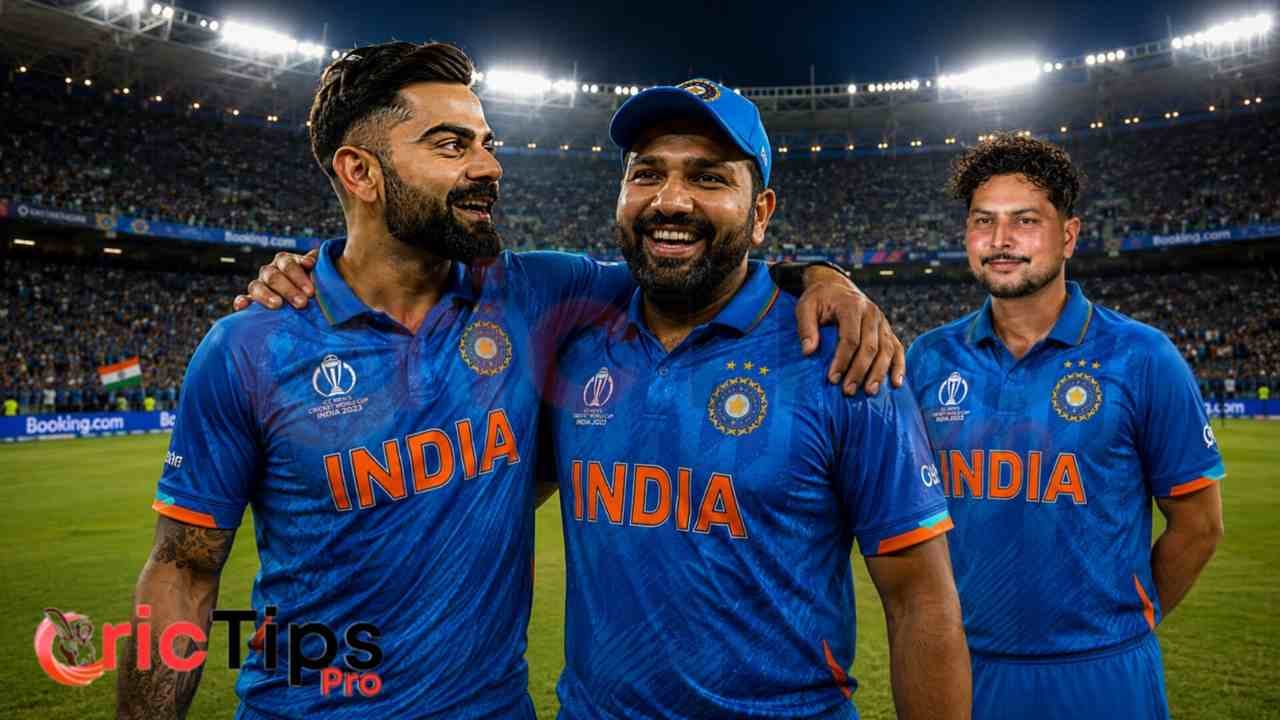
Virat Kohli and Rohit Sharma were India’s biggest hopes in white ball cricket as well. Kohli’s uncanny ability to handle pressure in big matches and Rohit’s devastating batting have led India to the final stages of back-to-back ICC tournaments. The biggest reward for that streak came by winning the 2024 ICC Men’s T20 World Cup. After 17 long years, India once again won the T20 World Cup and created a new history.
It was during this period that a new generation began to emerge in Indian cricket. Cricketers like Shubman Gill, Yashasvi Jaiswal, Rishabh Pant, Dhruv Jurel, Sarfaraz Khan and young talent Vaibhav Suryavanshi started proving themselves on the international stage. An environment was created for them, where confidence, fitness and a winning mentality were the biggest strengths.
Today the era of Virat Kohli and Rohit Sharma is not only remembered for records or trophies. During their time, India Cricket has become a team that aims to win at any ground in the world. This chapter in modern India Cricket History is therefore not just a success story, but a history of the development of a new identity for Indian cricket.
India’s Greatest Players, Records and Achievements
India Cricket History is not just a history of trophies or records, it is the story of all the legendary cricketers who have taught the world to recognize cricket in a new way. In every era, India Cricket has produced stars whose success has made India one of the strongest cricketing countries in the world.
Sachin Tendulkar still holds the highest position in the history of batting. He is unique as the owner of 100 centuries and the highest number of runs in international cricket. After him, Virat Kohli has become one of the best batsmen in modern cricket with consistent performances and numerous records.
At the same time, Sunil Gavaskar opened new horizons in Test cricket, Rahul Dravid became a symbol of reliability, and Rohit Sharma set one world record after another with his devastating batting in limited-overs cricket.
India Cricket has also gifted some of the best cricketers in the world in bowling. Anil Kumble, Kapil Dev, Ravichandran Ashwin and the current generation Jasprit Bumrah have taken Indian bowling to new heights with their performances.
Earlier, the famous Spin Quartet of Bishan Singh Bedi, E.A.S. Prasanna, B.S. Chandrasekhar and Srinivas Venkataraghavan had made India one of the best spin bowling teams for many years.
The contribution of legendary captains is equally important behind India’s success. Kapil Dev fulfilled the dream of winning the first World Cup, Sourav Ganguly gave the team a new mentality, MS Dhoni created history by winning three major ICC trophies and Virat Kohli ushered in a new era of aggressive and fitness-based Test cricket.
India’s success in ICC tournaments has increased consistently. Starting from the 1983 World Cup, 2007 T20 World Cup, 2011 ODI World Cup, 2013 Champions Trophy, 2024 and 2026 T20 World Cup—each title has enriched India Cricket History.
India’s presence in the world record list is also very strong. Sachin Tendulkar’s 100 international centuries, Virat Kohli’s record ODI centuries and Rohit Sharma’s world record innings of 264 runs are still some of the biggest milestones in cricket history.
The glory of Indian cricket is not limited to records. The first Test victory in 1952, the success of the historic overseas tour in 1971 and the incredible victory at the Gabba in the Border-Gavaskar Trophy in 2020–21 have shown that India Cricket always knows how to turn tough challenges into new history.
Conclusion
The future of Indian Cricket is stronger and more promising than ever before. New talent is emerging from every corner of the country, and IPL and domestic cricket are preparing them for the international stage. Young cricketers like Shubman Gill, Yashasvi Jaiswal, Tilak Varma, Mayank Yadav, Harshit Rana, Vaibhav Suryavanshi are proving that the foundation of Indian cricket’s future is already laid.
Not just men’s cricket, but Women’s Cricket is also progressing rapidly. The Women’s Premier League (WPL) is bringing out new talent, and Indian women cricketers are consistently proving their mettle on the international stage. As a result, it is now realistic to expect that Indian women’s cricket will achieve greater success in the coming decade.
Technology is also changing the future of Indian Cricket. Players’ performance is being evaluated more accurately through modern Data Analytics, AI, video analysis and fitness tracking. As a result, team selection, match planning and player development have now become much more scientific and effective than ever before.
However, behind this success lies a long Indian Cricket History. The 1983 World Cup win taught India confidence, the Sourav Ganguly era gave the team a fighting spirit, MS Dhoni taught them to stay calm under pressure, and the Virat Kohli and Rohit Sharma eras took Indian cricket to new heights of fitness, professionalism and world-class consistency. Each era has laid a solid foundation for the next generation.
Ultimately, India Cricket History is not just a glorified tale of the past; it is also an inspiration for the future. With the legacy of legends, the fearless mindset of a new generation and modern technology, India Cricket has become one of the pioneers of world cricket. More new records, new heroes and new history await ahead. So this journey of Indian cricket is not over yet—rather, the most exciting chapter may be about to begin now.
When did India play its first official Test match?
India played its first official Test match against England at Lord’s on 25 June 1932, becoming the sixth nation to receive Test status.
Why is the 1983 World Cup considered the biggest turning point in India Cricket History?
India’s 1983 World Cup victory under Kapil Dev transformed cricket into the nation’s most popular sport and marked the beginning of India’s rise as a global cricket powerhouse.
Who are the most influential players in India Cricket History?
Some of the most influential players include C.K. Nayudu, Sunil Gavaskar, Kapil Dev, Sachin Tendulkar, Sourav Ganguly, MS Dhoni, Virat Kohli and Rohit Sharma.
What role has the IPL played in India Cricket History?
Since its launch in 2008, the IPL has helped develop young talent, strengthened Indian cricket financially and increased its influence across world cricket.
What are India’s greatest achievements in international cricket?
India has won multiple ICC titles, including the 1983 and 2011 ODI World Cups, the 2007, 2024 and 2026 T20 World Cups, and the 2013 Champions Trophy, establishing itself as one of cricket’s strongest nations.