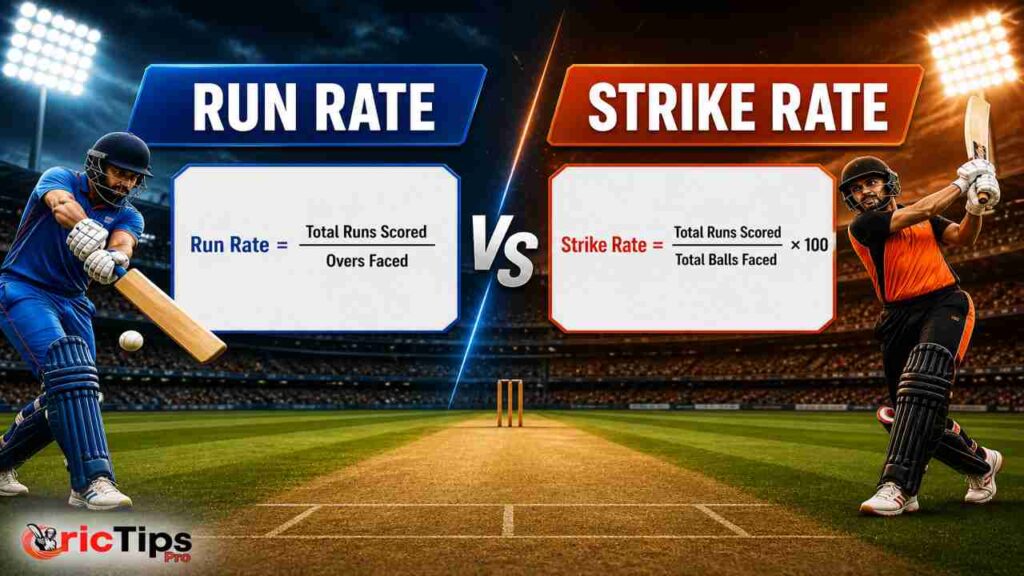
Strike Rate vs Run Rate The Difference That Helps You Truly Feel Cricket
When you watch cricket, the scoreboard shows many numbers runs, wickets, overs.But hidden behind these numbers is the real story of the game: the pressure, the strategy, and the decisions.
Many people ask: what is strike rate vs run rate, and why are they so important?
At first, the answer may seem simple.
But the truth is when you really understand the difference between these two, you start to feel the game on a deeper level.
Sometimes, whether a team will win or lose, or whether an innings will collapse or succeed.
These two numbers quietly tell the whole story.
So today, we are not just going to learn,
we are going to experience the meaning of strike rate vs run rate.

What is Strike Rate — A Batsman’s Heart Rate
When a batsman stands at the crease, he doesn’t just play the ball
He fights against time.
How fast he scores runs in that fight, we call it Strike Rate.
In simple words: Strike Rate = (Total Runs ÷ No. of Balls Played) × 100 Example: Suppose a batsman scores 70 runs in 70 balls. His Strike Rate = 100 But the story doesn’t end here… What if those same 70 runs come in just 35 balls?
Then Strike Rate = 200
Feel the difference
See? The runs are the same
But the impact is completely different.
One player is steady,
the other is explosive.
This is where the real significance of Strike Rate vs Run Rate beginsHow fast a player scores runs can change the entire rhythm of the match.
What is Run Rate — The Speed of the Whole Team
Now let’s talk about run rate.
Here, it’s not about one player, it’s about the entire team.
Simply put:
Run Rate = Total Runs ÷ Total Overs
Example:
Imagine a team scores 150 runs in 10 overs
Run rate = 15
What Does It Really Mean?
This number tells us how fast the team is moving forward in the match.
But there’s something important to understand
run rate is always a team game.
This is where strike rate vs run rate becomes interesting.
If one player scores quickly,
the team’s run rate goes up.
But if most players play slowly,
the run rate starts to drop.
So, cricket is not just about one heroit’s about how the whole team performs together.
Strike Rate vs Run Rate — Where is the Real Difference?
Now comes the real question:
What is the actual difference between strike rate vs run rate?
Simply understand it like this:
Strike Rate = Individual speed
Run Rate = Team speed
But the truth goes deeper
This difference is not just about numbers
it’s about mindset.
Feel the Situation
Imagine a batsman is playing at a strike rate of 200,
but the rest of the team is playing slowly…
The team’s run rate will not increase much.
On the other hand,
even if everyone is playing steady,
just one explosive player can completely change the momentum of the match.
Final Thought
So, strike rate vs run rate is not just a formulait’s all about balance.
A Real Example — Where Everything Changes
Let’s imagine a T20 match.
Team A : 70 runs in 10 overs Run rate = 7 One batsman : 40 runs in 20 balls Strike rate = 200 What is happening here?
One player is really trying to push this game forward but the rest of the team is not moving at the same pace.
What if another player also starts playing like this?
The run rate will quickly go up
Feel the Game
This small change clearly shows how
strike rate vs run rate are connected.
One player’s speed can inspire the team,
and together, they can completely change the flow of the match.
When Strike Rate Matters More and When Run Rate Takes Control in Cricket
When is Strike Rate More Important?
Not always, but sometimes the strike rate is everything. For example, in the last overs, the powerplay, or when chasing a target, the pressure keeps building if a batsman doesn’t score quickly.
That’s when strike rate becomes more important than run rate.
The Real Emotion
Here, strike rate vs run rate is no longer just numbers—
it becomes an emotional decision.
Should you take risks?
Or play safe?
When is Run Rate More Important?
At other times, run rate is what really matters.
For example:
Long innings (ODI, Test)
Building partnerships
Steady progress
Understand the Flow
Here, you don’t need to rush.
Playing slowly is okay , but you must stay consistent.

Conclusion
In the end, cricket is not just about runs or balls.
It is a game of time, patience, and decisions.
Many people think strike rate vs run rate are just two simple formulas.
But if you look a little deeper, you will realize
these two are actually the heartbeat of the match.
Feel the Game
When one batsman plays brilliantly,
and the team supports that momentum
that’s when history is created.
Next Time You Watch
So the next time you look at the scoreboard,
don’t just see the numbers.
Try to understand—
which one is strike rate,
which one is run rate,
and which one is telling the real story of the match.
Because the truth is—Cricket is not just played, it is felt.
What is strike rate in cricket?
Strike rate in cricket shows how fast a batsman scores runs. It is calculated by dividing total runs by balls faced and multiplying by 100.
What is run rate in cricket?
Run rate means how many runs a team scores per over. It is calculated by dividing total runs by total overs played.
What is the difference between strike rate vs run rate?
The main difference is that strike rate measures an individual batsman’s speed, while run rate measures the overall scoring speed of the team.
Which is more important: strike rate or run rate?
Both are important, but it depends on the situation. Strike rate matters more in fast scoring moments, while run rate is important for maintaining steady team progress.